
International groupage is a very useful logistics solution for companies that need to ship goods abroad without filling an entire truck or container.
But be careful: it’s not just “the cheapest shipping option.”
Consolidated shipping really works when it is chosen correctly, taking into account the quantity of goods, destination, delivery times, documentation, type of cargo, and level of urgency.
For some shipments, this is the most efficient option. For others, however, a dedicated shipment or an express service may be a better choice.
In this article, we’ll explore when international groupage is truly worthwhile, how it works in practice, and what mistakes to avoid before choosing this mode of transportation.
Discover INSPED’s international groupage shipping service
What Is International Groupage? Explained Simply
International groupage is a mode of transportation in which cargo belonging to different customers is consolidated within the same vehicle or logistics route.
In practice, instead of using an entire truck for a single shipment, multiple compatible loads are consolidated, organized, and routed to common geographic areas.
This allows for the optimization of space, costs, and routes.
The principle is simple: if the cargo does not fill an entire vehicle, it can be transported along with other shipments headed for the same area or for interconnected hubs.
One trip, multiple shipments
The main advantage of groupage is precisely this: sharing transportation without sacrificing organized management.
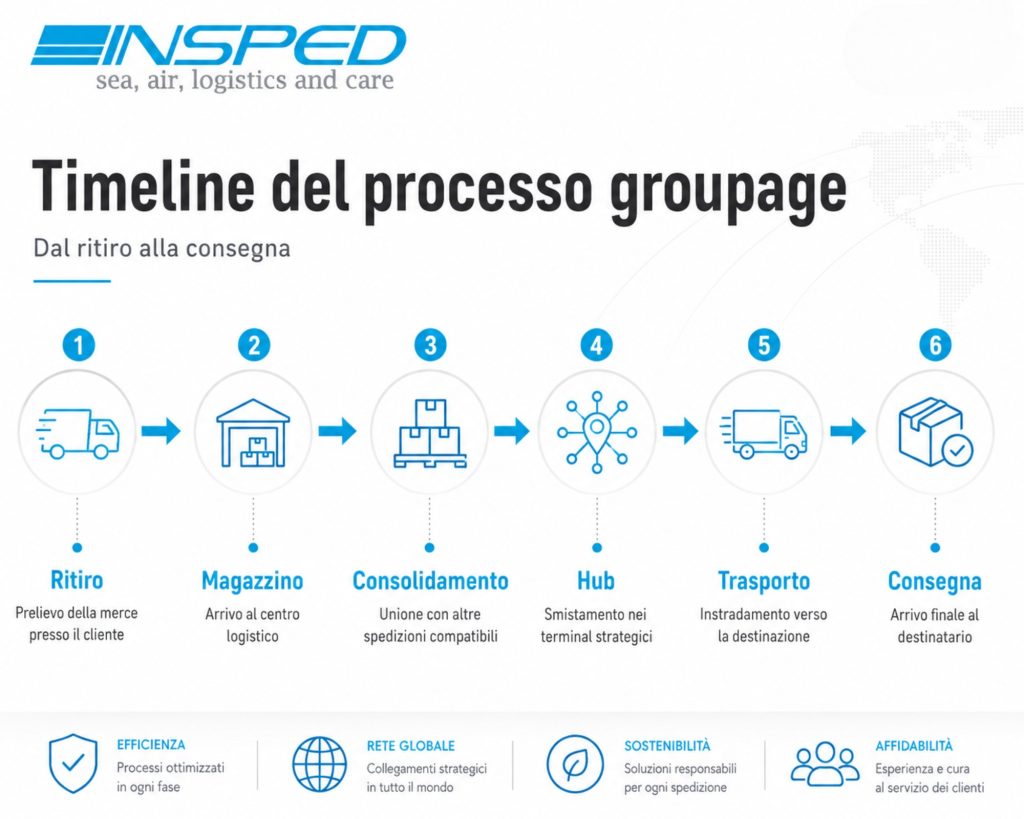
The goods are picked up, consolidated in the warehouse, routed to logistics hubs, and then delivered to the final recipient.
The process requires coordination, because every shipment must be tracked, identified, and managed properly throughout all operational phases.
Why a Dedicated Vehicle Isn’t Always Necessary
Not all companies need to rent an entire vehicle.
Many international shipments involve pallets, packages, or batches of goods that do not warrant dedicated transport.
In these cases, consolidated shipping allows for more efficient shipping, especially when delivery times can be planned and the destination is served by a well-established logistics network.
Learn more about international shipping for businesses
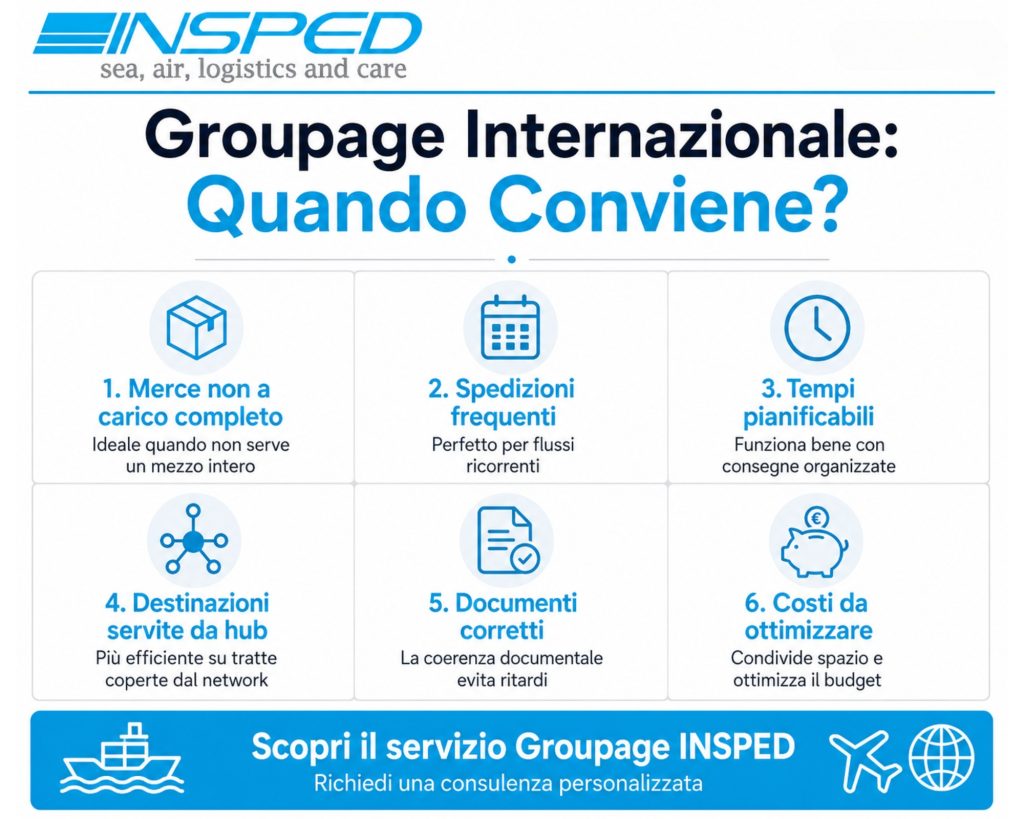
When Is It Best to Choose International Consolidated Shipping?
Consolidated shipping is a good option when the shipment’s characteristics are compatible with shared handling.
This solution is particularly well-suited for companies that ship regularly but not always with a full load.
It can also be useful when the goal is to reduce logistics costs while maintaining efficient transportation operations.
Frequent shipments, but not full truckloads
Groupage is ideal when a company needs to ship goods abroad fairly frequently, but the volume isn’t enough to fill an entire vehicle.
In these cases, sharing the available space helps avoid unnecessary costs.
It is a widely used solution for B2B shipments, recurring deliveries, industrial supplies, samples, pallets, and goods destined for various European markets.
Non-urgent goods, but requiring precise delivery
Consolidated shipping is suitable for shipments that do not require immediate departure or extremely urgent delivery.
This does not mean that it is a “slow” mode of transportation.
This means it requires proper planning: pickup, consolidation, departure, transit through hubs, and final delivery must all be organized in advance.
When delivery times can be planned, groupage can be a very effective option.
Optimization of Logistics Costs
One of the main reasons companies choose groupage is to optimize costs.
By sharing transportation with other shipments, you avoid paying for an entire vehicle when it isn’t necessary.
However, cost savings should not be the only factor in making a decision.
Effective groupage also requires a reliable network, document management, traceability, operational expertise, and clear timelines.
See also: How much does international shipping cost?
When Consolidation Isn’t the Best Choice
International groupage isn’t always the best solution.
In some cases, it may be best to choose dedicated shipping, an express service, or a specific shipping arrangement.
Understanding when not to use groupage is just as important as knowing when to use it.
Express Shipping
If the goods need to be shipped immediately or arrive within a very tight time frame, groupage may not be the ideal solution.
This is because the process involves stages of collection, consolidation, and routing.
When urgency is a priority, a dedicated service can provide greater control over timing and the route.
Discover our dedicated express services for urgent shipments
Fragile goods or goods subject to specific restrictions
Some goods require special care.
These may include fragile products, goods with handling restrictions, non-standard packages, goods with specific requirements, or loads that cannot be easily consolidated with others.
In such cases, it is necessary to carefully assess whether consolidated shipping is compatible with the type of goods.
Very strict deadlines
Consolidated shipping works well when the timelines are clear and predictable.
If, on the other hand, the delivery requires the highest priority, strict time constraints, or dedicated handling, it is necessary to consider different solutions.
The point isn’t to choose the cheapest service, but the one best suited to the shipment.
How International Groupage Shipping Works
An international groupage shipment follows a well-defined operational process.
Each step must be coordinated to ensure that the goods are picked up, consolidated, routed, and delivered correctly.
Pickup of Goods
The first step is pickup at the customer’s location or at the agreed-upon location.
At this stage, it is important that the goods are ready, identifiable, properly packaged, and accompanied by the necessary documentation.
A well-planned pickup reduces the risk of delays in subsequent stages.
Inventory Consolidation
After pickup, the goods are taken to a warehouse or a logistics terminal, where they are consolidated with other compatible shipments.
This step is central to groupage.
Here, the cargo is organized according to destination, route, timing, and type of goods.
Routing to Hubs and Terminals
Once consolidated, the goods are routed to the relevant logistics hubs.
Hubs make it possible to connect different geographic areas and improve the efficiency of international distribution.
In the case of INSPED, the logistics centers in Ornago and Brendola make it possible to coordinate shipments to numerous destinations in Europe and outside the EU.
Discover INSPED’s warehouses in Ornago and Brendola
Final Submission
The final step is delivery to the recipient.
This phase also requires coordination, as arrival times, any operational instructions, documents, and final confirmations must be managed.
An effective groupage shipment does not end when the vehicle departs; it ends when the goods arrive safely at their destination.
The Role of Hubs in International Groupage
In international groupage, the logistics network makes all the difference.
Having well-connected terminals and hubs makes it possible to schedule regular departures, handle varying volumes, and reach more destinations more efficiently.
Hubs are not just transit points.
These are operational hubs where shipments are sorted, consolidated, addressed, and inspected.
Why the Logistics Network Is Important
A well-organized network helps reduce delays, improve time management, and ensure greater consistency in departure times.
For a company that ships internationally, this means being able to rely on a more stable and predictable system.
The quality of groupage depends heavily on the quality of the logistics network that supports it.
From Italy to Europe and non-EU markets
Consolidated shipping is particularly useful for shipments to European destinations served by regular routes.
It can also be used for certain areas outside the EU, provided that the logistics network and documentation procedures are handled properly.
For this reason, it is important to rely on service providers who are familiar not only with the route but also with the documentation and customs procedures associated with the destination.
Learn more about transportation solutions in Europe
Consolidated Shipments, Documents, and Customs: What to Check Before Departure
Documents are also essential in groupage.
The fact that the shipment is shared does not diminish the importance of the documentation. In fact, in some cases, it makes it even more important, because the goods must be properly identified throughout the entire journey.
Accurate documents and consistent data
Before departure, it is important to verify that the documents contain complete and consistent information.
The CMR, commercial invoice, packing list, shipping references, and recipient information must be clear and consistent.
Errors or inconsistencies can slow down operational management, especially if the shipment involves destinations outside the EU or customs procedures.
Any customs procedures
When consolidated shipments are destined for non-EU countries or involve routes that require specific inspections, customs procedures may be necessary.
In these cases, it is important to prepare the documents before pickup and verify that all the information is correct.
Document management is an essential part of shipping, not a secondary step.
See also: Document errors that can hold up an international shipment
Discover INSPED’s customs services
Consolidated Shipping or Dedicated Transport: How to Choose
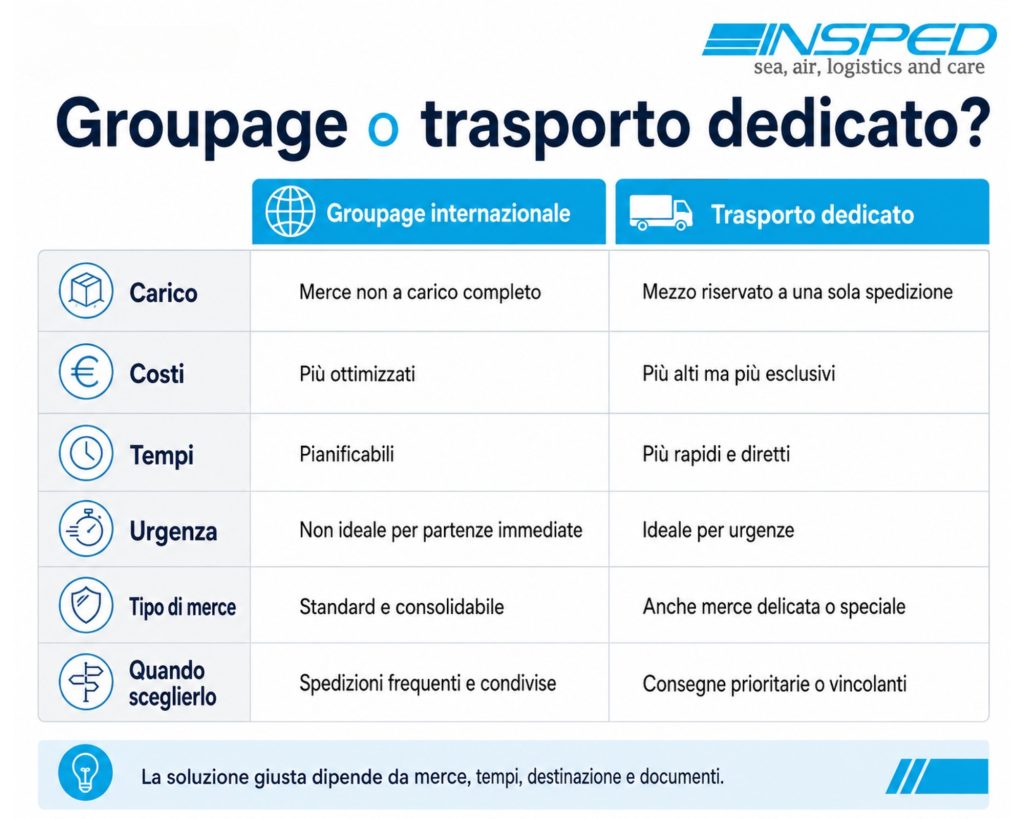
The choice between consolidated shipping and dedicated transport depends on several factors.
There is no single best solution.
There is a shipping solution that best suits your needs.
Cost
Groupage allows for cost optimization when the cargo does not fill an entire vehicle.
Dedicated transportation, on the other hand, may be more expensive, but it offers greater control over timing, routing, and operational management.
Weather
If delivery times can be planned, groupage can be an efficient solution.
If, on the other hand, the delivery is urgent, time-sensitive, or critical, dedicated transport may be more appropriate.
Type of goods
Standard, palletized, and easily consolidated goods are best suited for groupage.
Delicate, oversized, or special-handling cargo must be assessed with greater care.
Urgency
The most important factor is often urgency.
When a shipment can’t wait, groupage isn’t always the best solution.
In these cases, the operational assessment must take precedence over the price.
Mistakes to Avoid When Choosing Groupage
Choosing groupage just because it costs less is one of the most common mistakes.
Groupage is a smart solution, but it must be evaluated properly.
Consider only the price
Price is important, but it can’t be the only criterion.
A shipment that is too cost-conscious but not suitable for groupage can result in delays, complications, or additional costs down the line.
Do not take consolidation periods into account
Groupage requires a consolidation phase.
This means that the goods are not always shipped immediately after pickup.
If the customer has strict deadlines, it is necessary to assess whether groupage shipping is compatible with the scheduled delivery.
Neglecting documents and packaging
In groupage, the goods are transported together with other shipments.
For this reason, it must be properly packaged, labeled, and documented.
Goods that are not properly prepared can cause problems during handling, consolidation, or delivery.
See also: How International B2B Shipping Really Works
Why Operational Coordination Is Essential
International groupage requires coordination.
It’s not enough to consolidate multiple shipments into a single vehicle.
We need to organize pickups, warehouses, hubs, documents, routes, schedules, and final deliveries.
Each shipment has its own route, recipient, documentation, and priority.
The quality of service depends on the ability to manage all this information in an organized manner.
INSPED coordinates international groupage shipments through a structured organization, logistics terminals, selected partners, and an operations team capable of overseeing every stage—from pickup to delivery.
Go to the page dedicated to international groupage shipments
When to Request a Quote Before Choosing Groupage
There are cases in which it is advisable to request an assessment before choosing a mode of transportation.
For example, when the shipment is urgent, fragile, particularly bulky, destined for countries outside the EU, or involves complex documentation.
An initial assessment helps determine whether consolidated shipping is truly the most efficient solution or whether it would be better to opt for dedicated transport.
The point isn’t to ship using standard shipping.
The key is to choose the right shipping method for that specific shipment.
Contact INSPED to get a quote for your groupage shipment
FAQ — Frequently Asked Questions About International Groupage
What is international groupage?
International groupage is a mode of transportation in which cargo from multiple customers is consolidated onto the same vehicle or logistics route, allowing for the optimization of space, routes, and costs.
When is it convenient to choose groupage?
This is a good option when the cargo does not fill an entire vehicle, delivery times can be planned, and the destination is served by a well-organized logistics network.
Is groupage suitable for urgent shipments?
Not always. For shipments with very tight deadlines, a dedicated transport service or an express service may be more appropriate.
Is groupage safe?
Yes, provided that the goods are properly packaged, labeled, and documented, and that the shipment is handled through a reliable logistics network.
What is the difference between groupage and dedicated transport?
In groupage shipping, the cargo is transported along with goods from other customers. In dedicated transport, on the other hand, the vehicle is reserved for a single shipment.
Does groupage require customs documents?
It depends on the destination. For shipments outside the EU or on specific routes, customs procedures and specific documentation may be required.
Is groupage always a good idea?
No. It’s a good idea when the quantity, delivery times, destination, and type of goods are compatible with a consolidated shipment.
Do you have frequent shipments, but not always full truckloads?
International groupage can help you optimize costs, routes, and logistics planning without sacrificing control and traceability.
The INSPED team helps you determine whether consolidated shipping is the best solution for your shipment or whether it would be better to choose dedicated or express shipping.