
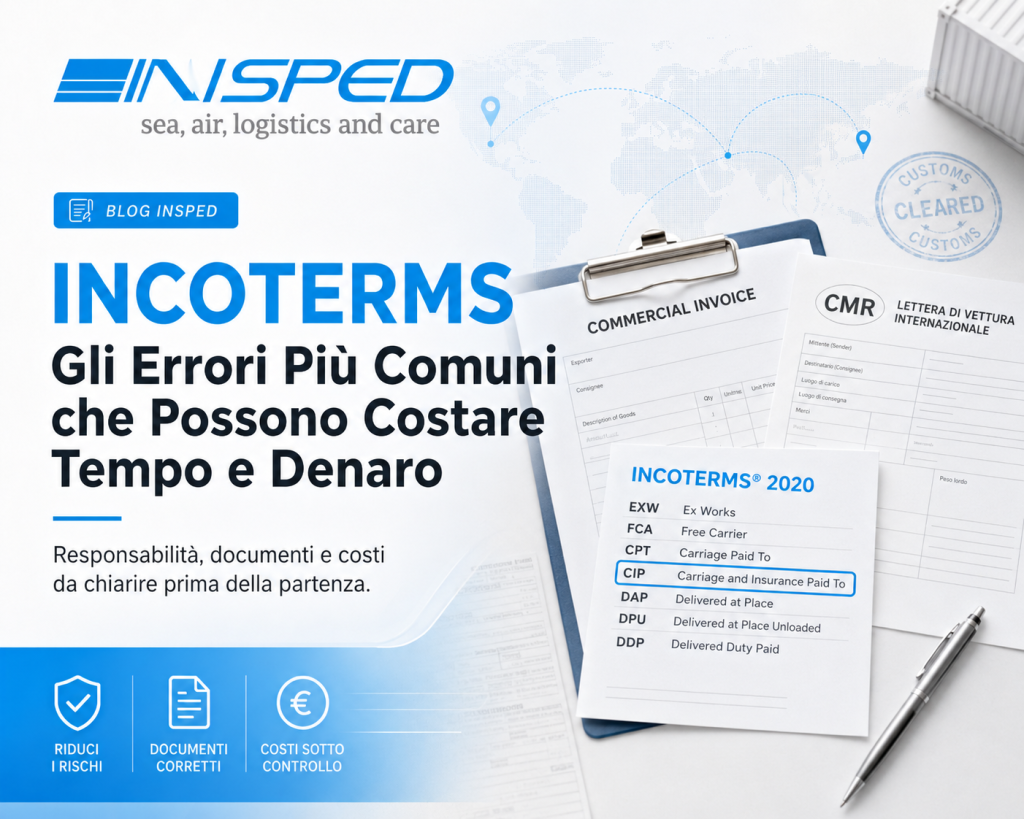
In international shipping, Incoterms are not just an acronym to be included on an invoice.
They are one of the elements that help define responsibilities, costs, obligations, and operational steps between the seller and the buyer.
When they are filled out correctly, they help clarify the handling of the shipment. When they are incorrect, incomplete, or inconsistent with the actual logistics operation, however, they can cause delays, misunderstandings, additional costs, and documentation issues.
That’s exactly the point: an error in the Incoterms doesn’t just stay on paper.
It can affect transportation, customs, the commercial invoice, risk management, the responsibilities of the parties, and final delivery.
For this reason, in international B2B shipments, Incoterms must be verified before the goods are shipped, not after a problem has already arisen.
Discover INSPED’s customs services
Why Incoterms Are Important in International Shipments
Incoterms serve to clarify certain fundamental aspects of international trade.
In particular, they help define who is responsible for certain steps, who bears certain costs, and at what point specific responsibilities are transferred between the seller and the buyer.
In practice, this affects several aspects:
- transportation arrangements;
- document management;
- customs procedures;
- shipping costs;
- insurance;
- operational responsibilities;
- communications between the shipper, recipient, and freight forwarder.
Incoterms do not replace the commercial contract and do not address every aspect of shipping, but they help avoid significant ambiguities.
The problem arises when they are used automatically, without verifying whether they match the actual shipment.
See also: How International B2B Shipping Really Works
Mistake 1: Using an Incoterm Without Understanding Its Operational Implications
One of the most common mistakes is choosing an Incoterm simply because “that’s how it’s always been done.”
In many companies, certain conditions are used out of habit, without assessing whether they are still appropriate for the route, the cargo, the destination, or the mode of transportation.
This can cause problems when a shipment has different characteristics than usual.
Why Habits Can Cause Delays
A seemingly correct code can lead to very different operational consequences.
It can affect who is responsible for arranging transportation, who must bear certain costs, who must handle specific documents, or who must manage specific customs procedures.
If these responsibilities are not clear before departure, the shipment may be delayed.
In international operations, clarity from the outset reduces the risk of subsequent communications, disputes, and operational delays.
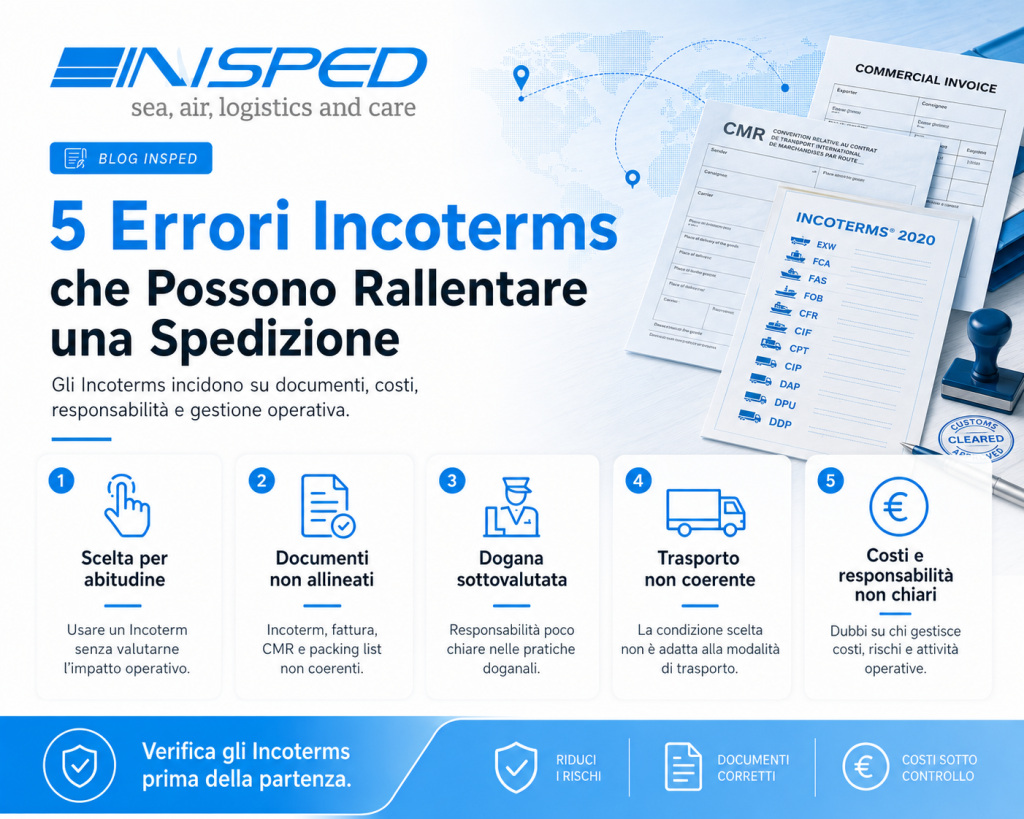
Mistake 2: Failure to Align Incoterms, Invoice, and Shipping Documents
Incoterms must be consistent with the commercial invoice and other shipping documents.
When the invoice specifies one term but the operational process follows another, this can lead to doubts, requests for clarification, and difficulties during customs clearance.
The documentation must describe the same shipment.
If the Incoterms, invoice, CMR, packing list, and operational instructions are not aligned, the process can become more complex.
The issue of document consistency
A discrepancy in the documents may seem minor, but it can lead to additional audits.
For example, if the commercial invoice specifies a different party responsible than the one actually handling the shipment, the parties involved may need to clarify who is responsible for certain steps.
This may result in delays, requests for corrections, or requests for additional documentation.
See also: Document errors that can hold up an international shipment
Mistake 3: Underestimating the Impact of Incoterms on Customs
Incoterms can also have an impact on customs procedures.
Not because they determine all customs procedures on their own, but because they influence costs, responsibilities, documentation, and relationships between the parties.
When it comes to shipments outside the EU—whether exports or imports—an unclear provision can raise questions about who is responsible for providing certain documents or handling specific steps.
Customs procedures and responsibilities must be clear
When a shipment requires customs clearance, it’s not enough for the goods to simply be ready.
You need the correct documents, consistent data, and clearly defined responsibilities.
If it’s unclear who is responsible for a particular step, you risk wasting time at the worst possible moment: when the goods are already in transit or awaiting release.
See also: Goods Held at Customs—What to Do and What Mistakes to Avoid
Mistake 4: Choosing an Incoterm Without Considering the Type of Transportation
Not all Incoterms are suitable for the same type of transportation.
Some conditions may be better suited to certain modes of transport, while others require greater attention when shipping by land, sea, air, or multimodal transport.
Choosing a shipping option without considering how the goods will actually be transported can create difficulties in managing the shipment.
The mode of transportation matters
An international shipment can involve several stages: pickup, domestic transport, hubs, customs, international legs, and final delivery.
If the Incoterm is not consistent with the mode of transportation and the actual logistics arrangements, questions may arise regarding risks, liabilities, and costs.
For this reason, the decision should not be based solely on commercial considerations, but also on operational ones.
Learn more about international shipping for businesses
Mistake 5: Not Verifying Who Is Responsible for Costs and Liabilities
Incoterms affect costs and liabilities.
One of the most common mistakes is failing to clarify in advance who pays for what and who is responsible for certain operational tasks.
When this distinction is unclear, disputes may arise between the seller, the buyer, the carrier, and other parties involved.
The cost is not just the shipping price
For international shipments, costs may include shipping, insurance, customs clearance, handling, any delays, documentation, special delivery arrangements, or additional services.
If it is unclear who is responsible for certain costs, the shipment may be delayed or lead to disputes later on.
Clarity before departure helps prevent problems during operations.
Mistake 6: Specifying the Incoterm Too Late
Another common mistake is addressing the issue of Incoterms only when preparing the documents.
In fact, the Incoterm should be verified before arranging the shipment.
If this is considered too late, it may become apparent that certain responsibilities are unclear, that the documentation is incomplete, or that the planned mode of transportation is not consistent with the specified conditions.
Incoterms should be verified before departure
In international logistics, many issues can be avoided by conducting a preliminary check.
Checking the Incoterm before shipment ensures that the invoice, shipping documents, operating instructions, customs procedures, and communications between the parties are all aligned.
This reduces the risk of bottlenecks, delays, and last-minute clarifications.
Mistake 7: Not Involving Those Who Actually Handle the Shipment
The choice of Incoterms is often made in the commercial sphere, but it also has an impact on logistics.
For this reason, it is helpful to involve those who will be handling the shipment on a day-to-day basis, especially when the shipment is international, the goods are complex, or the destination requires customs clearance.
A freight forwarder can help verify whether the stated conditions match the actual shipment.
Operational coordination prevents future problems
An initial discussion among the company, the freight forwarder, and other parties involved helps clarify responsibilities, documentation, timelines, and critical steps.
This does not mean superseding the commercial agreements between the seller and the buyer, but rather verifying that the logistics process is consistent with what is specified in the documents.
Contact INSPED for assistance with your international shipment
How to Avoid Mistakes with Incoterms
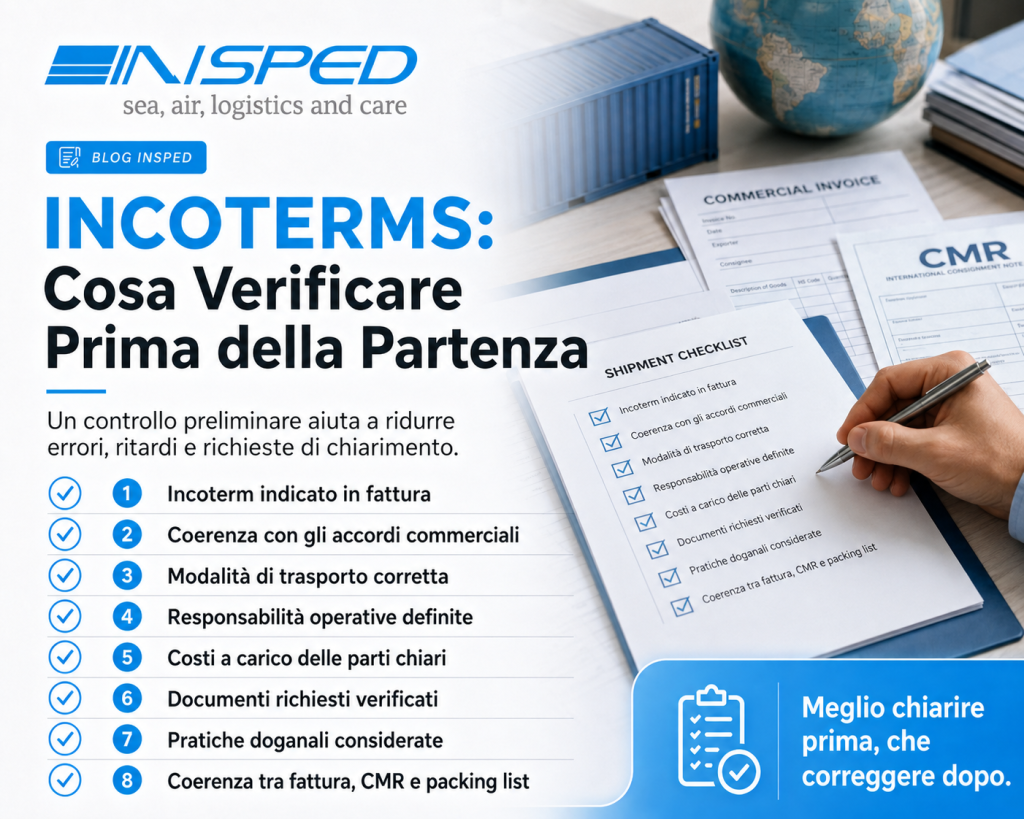
To reduce the risk of errors, it’s helpful to include Incoterms in your preliminary shipment checks.
Before departure, the company should verify the following:
- Incoterm specified on the invoice;
- consistency with commercial agreements;
- consistency with the mode of transport;
- Operational responsibilities;
- costs borne by the parties;
- required documents;
- any customs procedures;
- Consistency of data between the invoice, CMR, and packing list.
The verification should not be viewed as a mere bureaucratic formality.
It is part of logistics planning.
Learn more about what to do when goods are held up at customs
Incoterms and Logistics Coordination
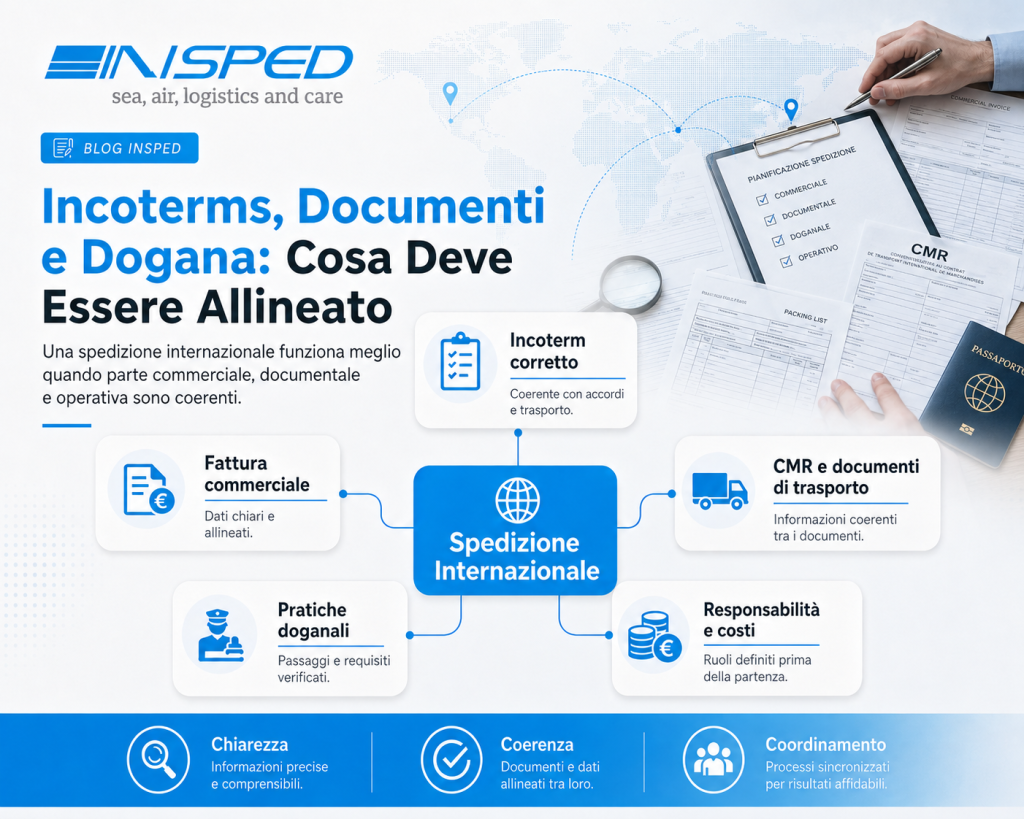
Incoterms work best when integrated into a well-organized logistics management system.
An international shipment requires coordination among documentation, transportation, customs, timelines, and operational communications.
If the Incoterms are clear but the rest of the documentation is inconsistent, the risk remains. Similarly, if the shipment is well organized but the commercial terms are not aligned, misunderstandings may arise.
The quality of a shipment stems from the alignment between the commercial, documentary, and operational aspects.
INSPED’s Support for International Shipping Management
INSPED supports companies and operators in managing international shipments, customs procedures, export/import documentation, and B2B transportation.
In the case of Incoterms, the operational role consists of helping the company verify that the specified terms are consistent with the shipment to be arranged, the available documentation, and the intended destination.
The goal is to reduce errors, delays, and operational issues before the goods are shipped.
Learn about INSPED’s support for customs procedures and international shipments
FAQ — Frequently Asked Questions About Incoterms Errors
What are Incoterms?
Incoterms are rules used in international trade to define certain obligations, costs, and responsibilities between the seller and the buyer.
Why can an Incoterms error cause delays?
Because it can create uncertainty about who is responsible for handling documents, costs, customs procedures, or the operational steps involved in the shipment.
Do Incoterms affect customs?
Yes, they can impact customs management because they influence documentation, costs, and responsibilities between the parties.
Where should Incoterms be indicated?
Incoterms are generally indicated in commercial documentation, such as the invoice, and must be consistent with the agreements and operational management of the shipment.
Who decides which Incoterm to use?
This decision stems from the commercial agreements between the seller and the buyer, but it should also be reviewed from a logistical and documentation standpoint.
When should you check the Incoterms?
Before the goods are shipped, along with the other shipping documents: commercial invoice, CMR, packing list, and customs documents.
Do you want to reduce errors and delays in your international shipments?
Incoterms aren’t just an acronym to add at the last minute.
They’re one of the elements that help make an international shipment clearer and more coordinated.
The INSPED team supports companies and operators in managing international shipments, customs procedures, and export/import documentation, helping to reduce errors, delays, and operational issues.