

When goods are held up at customs, the problem isn’t just the delay in delivery.
For a company, a delayed shipment can mean slowed production, customers waiting, additional costs, documents that need to be corrected, and urgent communications to handle with suppliers, recipients, carriers, and logistics providers.
In most cases, goods held up at customs are not the result of a single obvious error. They are often the result of a combination of factors: incomplete documentation, inconsistent data, required inspections, incorrect customs codes, values that need to be verified, or missing information.
The first thing to do is to avoid giving off-the-cuff answers.
When an international shipment is held up, it’s important to quickly determine why it’s been held up, which documents are involved, and which procedural step needs to be resolved.
Discover INSPED’s customs services
Why Goods Might Be Held Up at Customs
A shipment can be held up at customs for many reasons.
This does not always mean that a serious error has been made. In some cases, it is simply a routine check. In other cases, however, the hold is due to incomplete documents, inconsistent data, or information that needs to be clarified.
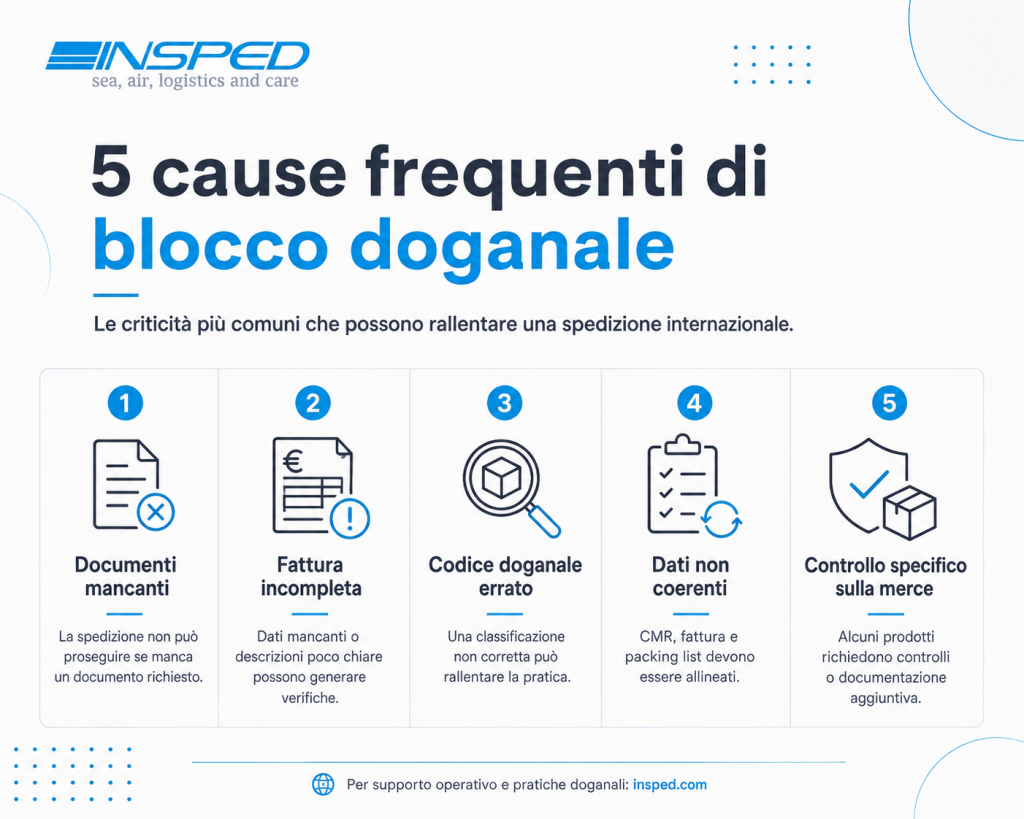
The most common causes include:
- missing or incomplete documentation;
- incorrect commercial invoice;
- incorrect customs code;
- value of goods to be verified;
- The product description is too general;
- Unclear Incoterms;
- specific checks based on product type;
- Discrepancies between the CMR, the invoice, and the packing list.
Customs must be able to correctly identify the goods, their value, origin, destination, and operational responsibilities. When any of these elements is unclear, the shipment may be subject to additional inspections.
See also: Document errors that can hold up an international shipment
The First Thing to Do: Figure Out the Reason for the Blockage
When goods are held up at customs, the first step isn’t to just “send another document” at random.
The first step is to figure out exactly what information is missing or what needs to be clarified.
We need to check whether the block affects:
- a document review;
- a request for additional information;
- a customs classification issue;
- a verification of the declared value;
- an issue related to the origin of the goods;
- a physical examination;
- an inconsistency between documents.
Every cause requires a different response.
Submitting unsolicited documents or uncoordinated information can further complicate the processing of the case.
Why We Need a Systematic Review
A well-organized review helps reduce downtime and unnecessary communication.
An international shipment often involves multiple parties: the shipper, the recipient, the carrier, the freight forwarder, customs, and logistics providers.
If everyone sends incomplete or uncoordinated information, there is a risk of prolonging the process rather than shortening it.
For this reason, it is important to identify a point person and gather all the documents before proceeding with any additions.
Documents to Check Right Away
When a shipment is held up at customs, the documents are almost always the first thing to check.
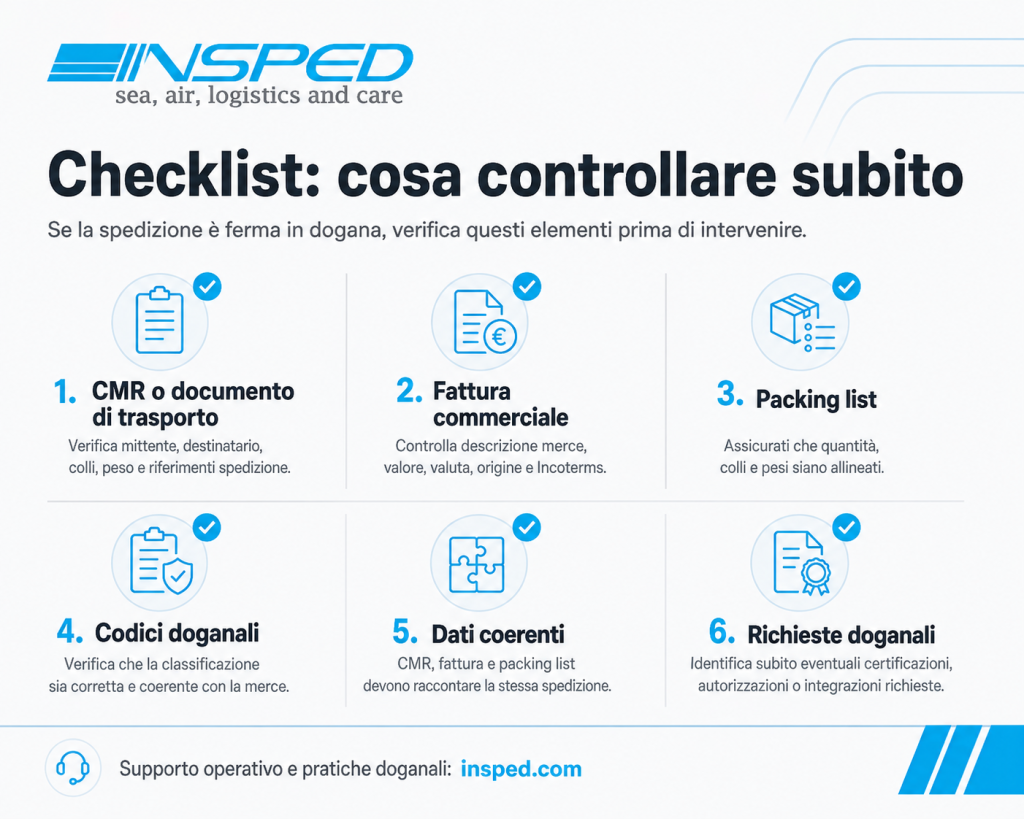
The main documents to check are:
- CMR or bill of lading;
- commercial invoice;
- packing list;
- export/import documents;
- any certifications;
- specific authorizations;
- customs codes;
- Incoterms;
- Shipping references.
The goal is not only to verify that the documents exist, but also to ensure that they are consistent with one another.
A commercial invoice may be present but incomplete. A packing list may be attached but not consistent with the CMR. A customs code may be listed but incorrect for the goods.
The Issue of Document Consistency
Many customs hold-ups result from inconsistent data.
For example, the number of packages may differ between the CMR and the packing list. The weight may not match. The description of the goods may be too general. The declared value may require further verification.
The documentation must describe the same shipment in a clear, complete, and legible manner.
See also: How International B2B Shipping Really Works
Commercial Invoice: One of the Most Critical Documents
The commercial invoice is one of the most important documents in international shipping.
It is not just used to indicate an amount. It is used to identify the goods, the declared value, the seller, the buyer, the terms of trade, and the information required for customs processing.
An incomplete invoice can lead to requests for clarification and slow down the entire shipment.
What to Check on the Invoice
Before submitting additions or corrections, it’s a good idea to check:
- complete sender and recipient information;
- a clear description of the merchandise;
- declared value;
- currency;
- quantity;
- number of packages;
- weight;
- country of origin;
- Incoterms;
- Shipping information.
A description that is too general can be a problem, especially for technical or industrial goods, or goods subject to specific inspections.
Writing “miscellaneous items,” “components,” or “accessories” may not be sufficient for a correct customs valuation.
Learn more about international shipping for businesses
Incorrect or Unverified Customs Codes
Another common reason for delays involves the customs classification of goods.
The customs code is used to identify a product based on specific criteria. Duties, inspections, required documentation, and applicable procedures may depend on this classification.
If the code is incorrect or does not match the description of the goods, customs may require additional verification.
Why the customs code isn’t just a minor detail
The customs code is not just an administrative formality.
It is one of the factors that determines how goods are treated from a customs perspective.
Incorrect classification can slow down shipping, lead to requests for clarification, or require corrections to the documentation.
For this reason, it is best to verify the code before shipment, especially when shipping industrial goods, technical products, components, machinery, or shipments to non-EU countries.
Goods Held Due to Missing Documents
In some cases, the shipment is held up because a required document is missing.
This may be a certificate, a declaration, an authorization, or an export/import document required for that specific goods or destination.
The problem with missing documents is that it often comes to light once the shipment is already underway.
This inevitably causes a delay, because the process cannot continue until the documentation has been properly completed.
How to Reduce Risk Before Departure
The best way to avoid this problem is to conduct a document review before pickup.
The preliminary review must take into account not only standard documents but also any specific requirements related to:
- country of destination;
- type of merchandise;
- declared value;
- product origin;
- any specific regulations;
- whether any inspections or certifications are required.
In international logistics, prevention is almost always faster than correction.
See also: Operational Guide for Drivers and Carriers
How Long Can a Customs Hold Last?
There is no standard duration for a customs hold.
The processing time depends on the reason for the hold, the type of review, the completeness of the documentation, and how quickly the requested information is provided.
A document review can be completed quickly if the data is clear and the supporting documents are available. A more complex issue, on the other hand, may take longer to resolve.
What Factors Determine the Timelines?
Processing times may depend on:
- type of merchandise;
- country of origin or destination;
- completeness of the documents;
- the need for physical inspections;
- requests for clarification;
- document corrections;
- response from the parties involved.
When documentation is organized and coordination is swift, problem management becomes more efficient as well.
What Not to Do When Goods Are Held at Customs
When a shipment is held up, rushing can lead to mistakes.
One thing to avoid is sending unverified documents or conflicting information.
It is important not to increase the volume of communications without a clear operational strategy.
The Most Common Mistakes Made During Lockdown
Some of the most common mistakes include:
- submitting incomplete documents;
- modify data without coordination;
- provide different versions of the same information;
- do not verify the consistency between the invoice, the CMR, and the packing list;
- to underreport the customs declaration;
- Do not involve an expert right away.
Disorganized management can cause delays.
A coordinated approach, on the other hand, makes it possible to understand the problem, gather the right information, and respond more effectively.
When You Need the Help of a Freight Forwarder
When goods are held up at customs, the assistance of an international freight forwarder can make all the difference.
Not because it can eliminate all oversight, but because it can help identify the problem accurately, coordinate documents, communicate with the parties involved, and reduce operational errors.
An experienced freight forwarder understands the ins and outs of international shipping and knows which details to check right away.
The Operational Role of the Freight Forwarder
The role of a freight forwarder is not just to organize transportation.
In the event of customs delays, it can assist the company in verifying documents, managing communications, and identifying the required information.
INSPED supports companies and operators in managing international shipments, customs procedures, and export/import documentation, with the goal of reducing delays, errors, and operational issues.
Contact INSPED for assistance with shipping and customs procedures
How to Prevent Customs Delays in Upcoming Shipments
Goods held up at customs can also provide an opportunity to improve internal processes.
After resolving the issue, it is helpful to analyze what caused it and what checks can be implemented before the next shipment.
Prevention hinges on a few key elements:
- complete documents;
- consistent data;
- correct customs codes;
- Clear Incoterms;
- updated shipping information;
- prior verification of the destination;
- coordinated communications.
In international shipping, many delays can be avoided even before the goods are shipped.
Learn more about the most common documentation errors in international shipping
FAQ — Frequently Asked Questions About Goods Held at Customs
Why do goods get held up at customs?
A shipment may be held up due to missing documents, inconsistent data, incomplete invoices, incorrect customs codes, specific inspections, or requests for clarification from customs.
What should you do if your shipment is held up at customs?
The first thing to do is to determine the reason for the hold, gather all the shipping documents, and check what information or additional documents are required.
How long does a customs hold last?
The duration depends on the reason for the hold, the type of review, and how quickly the requested documents or clarifications are provided.
Can the goods be held up even if the documents are present?
Yes. The documents may be present but incomplete, out of date, or inconsistent with one another. Even a minor inconsistency can trigger additional reviews.
Who can help clear a shipment through customs?
An international freight forwarder can assist the company with document verification, operational coordination, and managing communications related to customs clearance.
How can you avoid customs delays in future shipments?
Before departure, it is a good idea to check the invoice, CMR, packing list, customs codes, Incoterms, the origin of the goods, and any specific requirements of the destination country.
Do you have a shipment that’s been held up or a customs matter to handle?
Goods held up at customs require a systematic approach, proper documentation, and operational coordination.
The INSPED team supports companies and operators in managing international shipments, customs procedures, and export/import documentation, helping to reduce delays and issues.