
When people talk about international shipping, they often think only of transporting goods from one country to another.
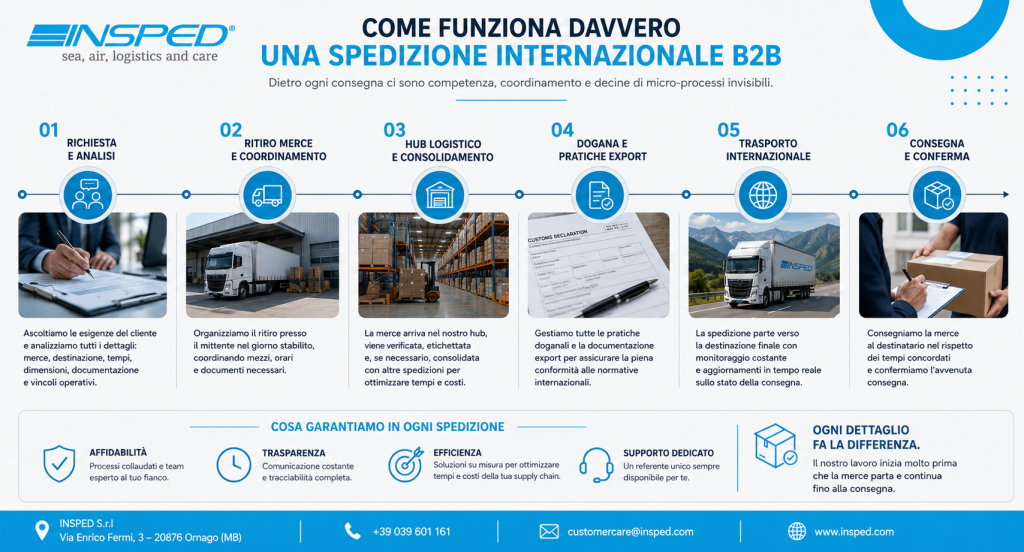
In reality, there is a much more complex process behind every international B2B shipment made up of planning, operational coordination, documentation, controls, contingency management and synchronization between different logistics operators.
Many of the most important activities remain invisible to the end customer, but it is those micro-processes that determine the success of an international shipment.
Links –> International Shipping
Everything Starts with a Request
Every international shipment begins with a detailed analysis of the customer’s request.
Before even arranging transportation, it is necessary to check: type of goods, destination, required timeframe, any customs requirements, and mode of operation.
Even seemingly simple shipments may require specific verifications related to:
– export documentation
– customs restrictions
– cargo type
– delivery timing
– pickup management
The initial phase is crucial because it allows all subsequent logistical planning to be built.
Analyzing the Expedition Before Departure
Every detail can influence:
– time
– costs
– transport mode
– document management
– operational coordination
For this reason, the management of an international shipment does not begin when the truck leaves, but much earlier.
Logistics Planning
Once the necessary information has been gathered, the planning phase begins.
At this stage, the following are coordinated: pickups, transportation, possible logistics hubs, operational timing, and document management.
Depending on the type of shipment, it may be necessary to arrange: dedicated transport, international groupage or multimodal transport.
Each choice affects:
- delivery time
- logistics costs
- operational management
- shipping flexibility
Groupage or Dedicated Transportation?
Not all shipments require the same type of management.
In some cases international groupage is the most efficient solution, while in other situations it is preferable to use dedicated transport to reduce time and operational complexity.
The Preparation of Documents
One of the most sensitive aspects of international shipping involves documentation.
Even small errors can generate: delays, additional checks or customs issues.
Some of the most commonly used documents include: CMRs, commercial invoices, packing lists, export/import documentation and customs references.
Each country may also require different verifications or procedures.
Why Documentation Is So Important
Many critical issues arise precisely from:
- incomplete data
- wrong codes
- missing documents
- discordant information
Instead, proper document preparation allows for faster controls and operational procedures.
What Happens During Transport
When the shipment leaves, operational work continues steadily.
During transport, the following are handled: tracking, updates, coordination between carriers, operational checks and any changes related to traffic, timing or unforeseen events.
An international expedition often requires simultaneous coordination between:
- companies
- drivers
- logistics hubs
- customs offices
- logistics operators
- final recipients
Behind the Tracking There Are Continuous Activities
Tracking does not just represent a geographical location.
Behind each update there are operational checks, communications, and controls to keep the expedition coordinated all along the way.
The Management of Unforeseen Events
In international logistics, unforeseen events are part of the daily work.
Among the most frequent problems:
- operational delays
- traffic
- customs controls
- incomplete documents
- timing changes
- discharge issues
The difference lies not in completely avoiding unforeseen events, but in the ability to handle them quickly through coordination and operational experience.
Why Coordination Is Essential
An international expedition often involves several parties at once.
For this reason, it is essential to maintain rapid communications and constant updates during all phases of operation.
The Final Delivery
Delivery also represents a delicate phase.
Before the shipment is finally closed, the following may be necessary: final documentary checks, coordination with the consignee, and operational confirmations.
The quality of end management directly affects the overall efficiency of the supply chain.
Each Delivery Is the Result of Dozens of Micro-Processes
Behind an international delivery there are activities that often remain invisible: checks, verifications, updates, logistics coordination and document management.
It is these details that make the difference between a smooth shipment and a problematic shipment.
Experience and Operational Management Make the Difference
International shipping requires more than just transporting goods.
The following are needed: operational experience, logistics coordination, document management, and the ability to deal quickly with any critical issues.
INSPED supports companies and operators on a daily basis in the management of international shipments, customs practices and Europe transport, coordinating all operational phases of the supply chain.
FAQ – Frequently Asked Questions
How long does an international shipment take?
It depends on the destination, type of goods, documentation and any customs procedures required.
What documents are needed for an international shipment?
Generally CMR, commercial invoice, packing list and export/import documentation are required.
What can slow down an international shipment?
Documentary problems, customs checks, traffic, operational delays or incomplete information.
How are logistical contingencies handled?
Through continuous operational coordination, constant updates, and rapid management of critical issues.
What is the difference between groupage and dedicated transport?
Groupage involves shipments shared among several customers, while dedicated transport uses a vehicle reserved for a single shipment.