
The Netherlands, or more correctly, the Netherlands, is one of the most attractive European markets for many Italian companies.
The distance is relatively manageable, the logistics infrastructure is well-established, and the country serves as a strategic hub for many European trade routes.
But precisely because the Netherlands is often perceived as an “easy” destination, some companies underestimate the importance of shipping planning.
Exporting to the Netherlands isn’t just a matter of loading the goods onto a truck and waiting for delivery. It involves properly organizing the documentation, timelines, mode of transport, any groupage arrangements, operational instructions, and coordination with the recipient, carrier, and logistics partners.
Even on European routes, minor errors can lead to delays, additional costs, or operational difficulties.
For this reason, a shipment from Italy to the Netherlands must be managed systematically, especially when it involves industrial goods, recurring shipments, B2B deliveries, or delivery times agreed upon with the end customer.
Discover INSPED’s service for shipments from Italy to the Netherlands
Why the Netherlands Is a Strategic Destination for Italian Companies
The Netherlands is a very important market for companies that export to Europe.
Its geographic location, the quality of its infrastructure, and the Netherlands’ role in international trade flows make this destination particularly attractive to many industries.
For an Italian company, shipping to the Netherlands can mean reaching direct customers, distributors, logistics hubs, warehouses, commercial operators, or distribution centers connected to other markets in Northern Europe.
The logistical advantage is clear.
But that doesn’t mean every shipment is automatic or free of issues.
A European shipment isn’t always a simple matter
Even when shipping within the European Union, organization, consistent documentation, clear timelines, and accurate instructions are essential.
The goods must be ready, identifiable, properly packaged, and accompanied by the necessary documents.
The recipient must be available to receive the shipment, and any delivery windows must be verified.
The difference between a smooth shipment and a problematic one often comes down to these very details.
Read also: How International B2B Shipping Really Works
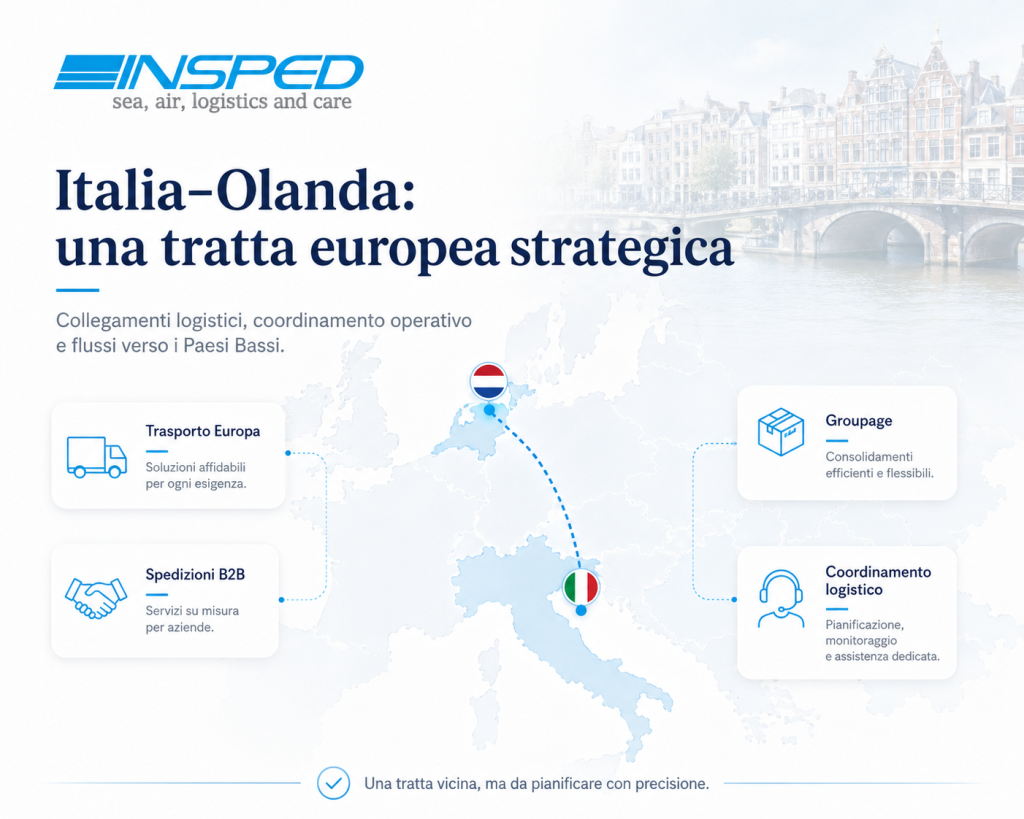
Shipping Goods to the Netherlands: What to Consider Before Shipping
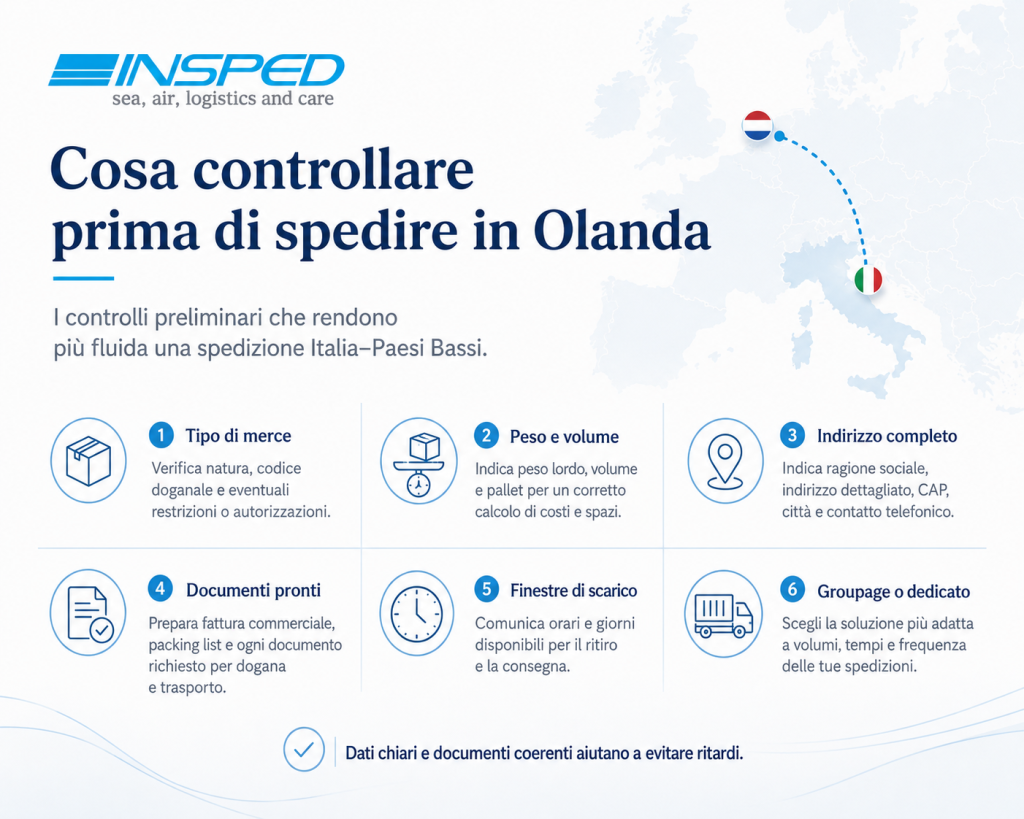
Before arranging a shipment to the Netherlands, it’s important to gather all the necessary operational information.
It’s not enough to just know the destination address.
You need to check:
- type of goods;
- weight and volume;
- number of packages or pallets;
- pickup location;
- complete delivery address;
- any unloading times or windows;
- Available documents;
- urgency level;
- possibility of consolidated shipping or need for a dedicated vehicle;
- any special instructions from the recipient.
This information helps you choose the most suitable logistics solution.
Why Initial Data Affects Timelines and Costs
A well-planned shipment starts with accurate data.
An incomplete address, an outdated weight, an incorrect number of packages, or an unverified unloading window can cause delays.
In B2B shipping, especially to international destinations, accuracy from the start prevents many corrections later on.
See also: Document errors that can hold up an international shipment
Documents for Exporting to the Netherlands: What to Check
For shipments to the Netherlands, documents must be clear, consistent, and available before pickup.
Even when non-EU customs procedures are not involved, commercial and shipping documentation remains essential for correctly identifying the goods and managing the logistics process.
Common documents may include:
- transport document;
- CMR for international road transport;
- commercial invoice, when required;
- packing list;
- order references;
- any technical documents or special instructions;
- complete sender and recipient information.
The goal is not to produce as many documents as possible, but to produce the right documents that are consistent with one another.
CMR and Transport Documents
In international road transport, the CMR is an important document because it accompanies the goods during the journey and contains essential information about the shipment.
Inconsistent or incomplete data can lead to requests for clarification, especially when the shipment involves multiple parties or multiple logistics stages.
For this reason, it is helpful to verify before departure that the CMR, packing list, invoice, and operating instructions are consistent with one another.
See also: Goods Held at Customs—What to Do and What Mistakes to Avoid
Groupage or dedicated transport to the Netherlands?
One of the most important decisions concerns the mode of transport.
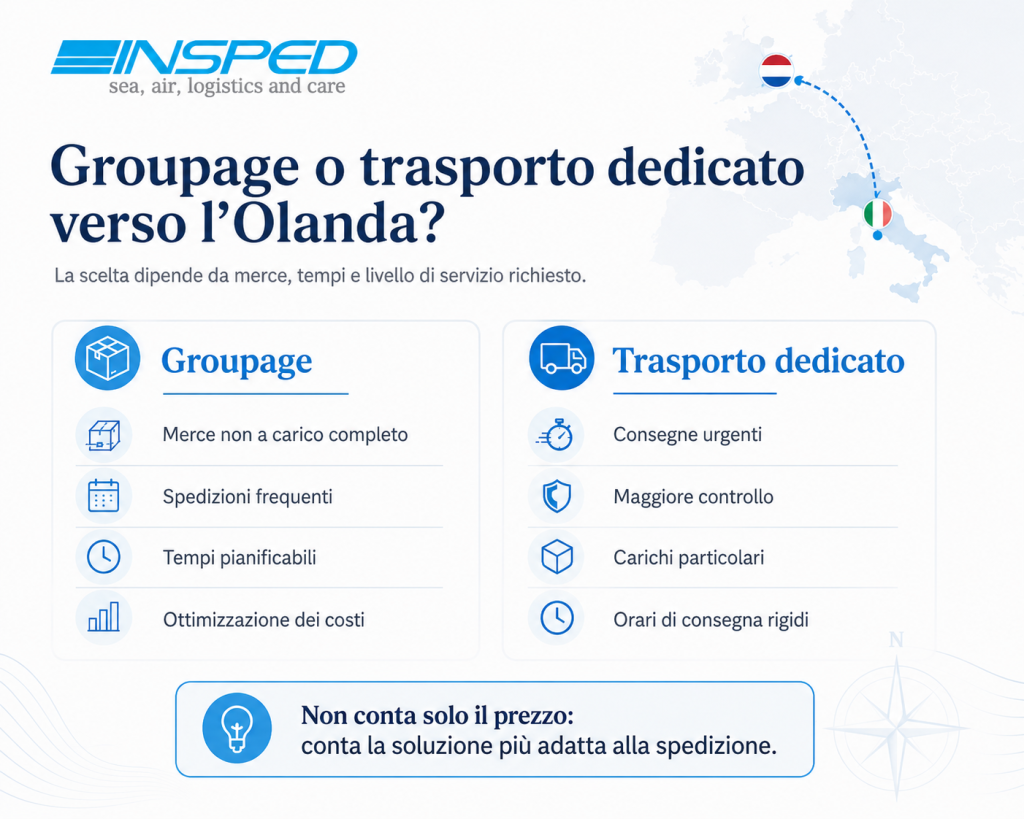
For many companies, groupage can be an effective solution when the goods do not fill an entire vehicle and delivery times are predictable.
In other cases, however, dedicated transport may be more suitable, especially when the shipment is urgent, the cargo is special, or the delivery requires greater control.
When Groupage to the Netherlands Is the Best Option
Groupage may be recommended when:
- the shipment is less than a full truckload;
- shipments are frequent;
- delivery times are flexible;
- the destination is served by regular routes;
- the cargo is standard or easily consolidated;
- the goal is to optimize logistics costs.
In these cases, sharing space with other compatible shipments can make transportation more efficient.
When Is Dedicated Transportation Needed
?
Dedicated transportation may be the best option when:
- The shipment is urgent;
- the goods are delicate or special;
- the delivery has strict time constraints;
- the customer requires greater oversight;
- the shipment cannot be easily consolidated;
- it is necessary to reduce intermediate steps.
The choice should not be guided solely by price, but by the compatibility between the goods, timing, destination, and the required level of service.
See also: International groupage—when is it really worth it for companies?
Discover INSPED’s international groupage service
The Most Common Challenges in Shipments from Italy to the Netherlands
Shipments to the Netherlands may seem straightforward, but in practice, various challenges can arise.
Among the most common are:
- Goods not ready at the time of pickup;
- incomplete delivery information;
- inconsistent documentation;
- errors in weight, volume, or number of packages;
- unconfirmed unloading windows;
- incorrect choice between groupage and dedicated shipping;
- underestimation of transit times;
- lack of operational instructions for the recipient.
These are problems that often have less to do with distance than with how the shipment is organized.
Attention to operational details makes all the difference
A well-managed European shipment requires attention to detail.
Just because a route is frequent doesn’t mean every delivery is the same.
Every shipment has specific characteristics: cargo, customer, destination, urgency, documentation, access points, and delivery constraints.
For this reason, even on established routes, operational coordination remains essential.
Shipping times to the Netherlands: What do they depend on
?
Shipping times from Italy to the Netherlands can vary depending on several factors.
Distance is just one of them.
The following also play a role:
- point of departure in Italy;
- destination in the Netherlands;
- chosen mode of transportation;
- consolidated shipment or dedicated vehicle;
- availability of the goods;
- accuracy of the documents;
- any stops at hubs;
- loading and unloading windows;
- operating conditions along the route.
A well-planned shipment allows for more accurate time estimates and reduces the risk of delays.
Why groupage requires planning
In groupage, goods may pass through consolidation stages and logistics hubs.
This is not a problem if the shipment is planned correctly.
However, it becomes a critical issue when the customer expects immediate handling or does not take into account the time required for consolidation.
For shipments with particularly urgent needs, it’s always best to consider a dedicated solution.
Read also: Inside an urgent shipment—what happens when time is tight
Exporting to the Netherlands: Mistakes to Avoid
When exporting to the Netherlands, the most common mistakes aren’t always major customs or logistics errors.
It is often practical oversights that slow down shipping.
Some mistakes to avoid:
- Prepare the goods at the last minute;
- failing to verify weight and volume;
- submitting incomplete documents;
- using unclear descriptions of the goods;
- choosing groupage even when urgent delivery is needed;
- failing to specify delivery windows;
- failing to verify the recipient’s access and availability;
- failing to properly coordinate the shipper, carrier, and recipient.
The shipment doesn’t begin when the truck leaves
A shipment to the Netherlands begins before pickup.
It begins when data, documents, and operational instructions are gathered.
When this phase is managed well, the shipment goes more smoothly.
When it is underestimated, even a European shipment can become more complex than expected.
See also: Incoterms—the most common mistakes that can cost time and money
The role of Incoterms in shipments to the Netherlands
Even in European shipments, Incoterms can play an important role.
They should not be treated as a code to be automatically included on an invoice, but rather as an item to be verified in light of commercial agreements and logistics management.
Incoterms help clarify costs, responsibilities, and obligations between the seller and the buyer.
If they are unclear or inconsistent with the shipment, they can lead to operational misunderstandings.
Who Pays for What and Who Manages What
One of the most sensitive issues concerns the distinction between who bears the costs and who manages certain steps.
The sender and recipient must be clear about the responsibilities of each party.
This clarity reduces the risk of disputes, delays, and last-minute notifications.
Learn More About Incoterms Mistakes in International Shipping
An often-overlooked challenge: final delivery
When shipping to the Netherlands, the challenge isn’t always the Italy-Netherlands leg.
Sometimes the most challenging part is the final delivery: unloading schedules, access points, recipient instructions, urban areas, warehouses, logistics hubs, or the need to coordinate multiple parties.
For this reason, a shipment should not be planned based solely on distance, but on the actual destination.
It’s not just about getting to the Netherlands. It’s about getting to the right place, at the right time, with the correct documents and with the operational instructions already clarified.
This topic will be explored in greater depth in a case study focusing on shipments from Italy to the Netherlands, which will illustrate how a seemingly simple route can require coordination, proactive planning, and operational oversight.
When to Request Assistance for a Shipment from Italy to the Netherlands
It’s helpful to request assistance from an international freight forwarder when a shipment requires planning, coordination, and selecting the most suitable solution.
This is especially true when:
- Shipments are recurring;
- the shipment is not a full truckload;
- it is necessary to evaluate groupage or dedicated shipping;
- there are deadlines to meet;
- the goods are industrial or delicate;
- the recipient has specific instructions;
- Consistent documentation is required;
- the company wants to optimize costs and logistics organization.
INSPED supports Italian companies in managing shipments to the Netherlands, European transport, international groupage, and customized solutions, with the goal of making the process more organized, efficient, and traceable.
Contact INSPED for a shipment from Italy to the Netherlands
FAQ — Frequently Asked Questions About Exporting to the Netherlands
What documents are required to ship goods to the Netherlands?
For a shipment to the Netherlands, you may need a bill of lading, CMR, packing list, commercial invoice (when required), order references, and complete sender and recipient information.
Is groupage a good option for shipping to the Netherlands?
Groupage can be a good option when the goods do not fill an entire vehicle, delivery times can be planned, and the destination is served by regular routes.
When is it best to choose dedicated freight to the Netherlands?
Dedicated freight may be more suitable when the shipment is urgent, the goods require greater oversight, or the delivery has specific constraints.
What mistakes should you avoid when exporting to the Netherlands?
The most common mistakes involve incomplete data, inconsistent documents, goods not ready for shipment, incorrect weight or volume, and choosing the wrong mode of transportation.
Do shipments to the Netherlands require customs clearance?
For shipments within the European Union, customs procedures are not typically an issue as they are for non-EU countries, but it remains essential to have the correct commercial and shipping documents.
How long does shipping from Italy to the Netherlands take?
Delivery times depend on the origin, destination, mode of transport (groupage or dedicated), availability of the goods, and delivery instructions.
Do you need to organize a shipment from Italy to the Netherlands?
Exporting to the Netherlands requires organization, accurate documentation, and the right choice of transportation mode.
Whether it’s groupage, dedicated transport, or recurring shipments, INSPED supports Italian companies in managing shipments to the Netherlands and in the operational coordination of international logistics.
Request assistance for a shipment from Italy to the Netherlands