

An international express shipment isn’t just a “faster” shipment.
This is a shipment in which every step must be evaluated, coordinated, and monitored with greater care, because the margin for error is smaller and the available time is limited.
When a company needs to deliver goods, components, documents, or materials within tight deadlines, it’s not enough to simply find an available vehicle. It’s necessary to quickly determine what needs to be shipped, from where, to which destination, with what documents, under what constraints, and with what level of priority.
In international B2B logistics, urgency isn’t just a concern during transport.
This is handled before departure.
Discover INSPED’s dedicated express services
When a Shipment Becomes Urgent
A shipment can become urgent for many reasons.
There may be a production line waiting for a component, an end customer who needs to receive the goods by a specific date, a trade show with fixed deadlines, or a delivery that has been delayed at an earlier stage of the supply chain.
In these cases, the problem isn’t just “getting it out quickly.”
The real goal is to get it out the right way.
A poorly managed urgent shipment can lead to further delays, additional costs, or documentation issues. An urgent shipment managed methodically, on the other hand, can reduce risk and save time wherever possible.
See also: How International B2B Shipping Really Works
Phase One: Understanding What’s Really Needed
When an urgent request comes in, the first step is to gather precise information.
Before arranging transportation, you need to understand:
- What needs to be shipped;
- where the goods are located;
- where it needs to be delivered;
- by when it must be delivered;
- what documents are available;
- whether there are any customs restrictions;
- whether the goods require special handling;
- whether a dedicated vehicle or an alternative solution is needed.
This step is crucial because a decision made too quickly, without verifying the information, can cause problems in subsequent stages.
Urgency does not eliminate the need for planning
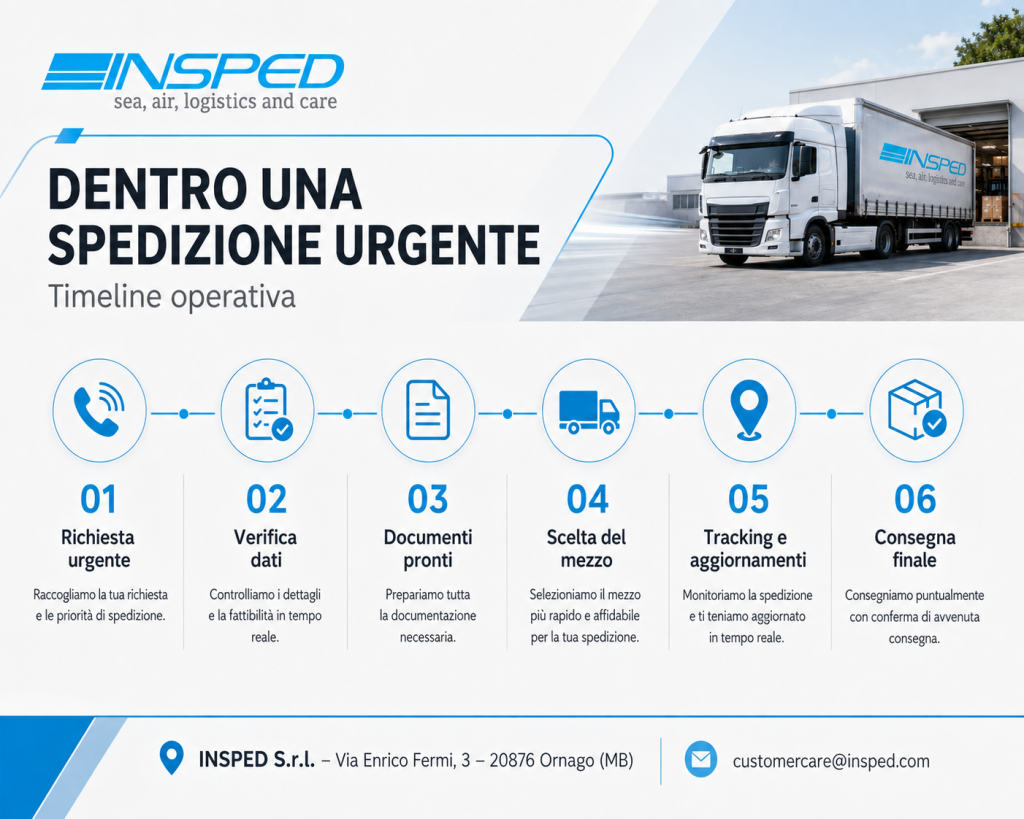
When time is tight, planning becomes even more important.
Any missing information can cause delays: an incomplete address, an incorrect reference, a document that isn’t ready, or an unverified delivery window can jeopardize the entire operation.
For this reason, even with urgent shipments, the first step is always analysis.
Documents and Information: What to Check Right Away
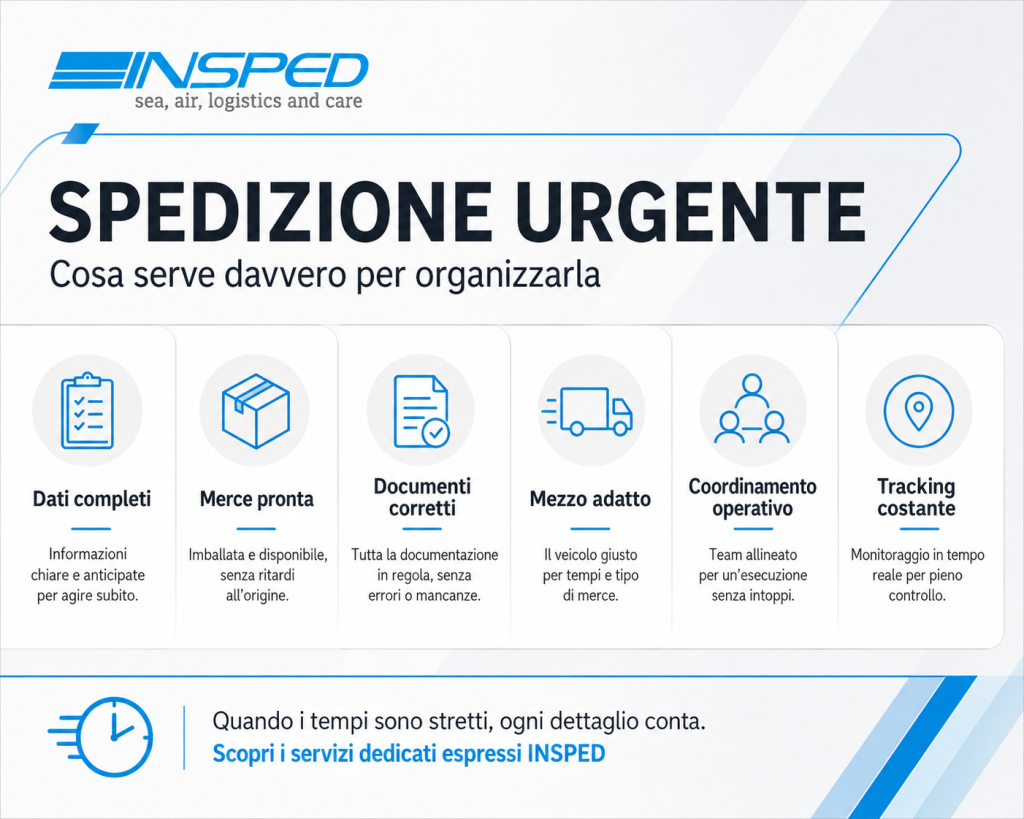
With an urgent shipment, the documents cannot be sent back.
If goods are shipped without the proper documentation, there is a risk of wasting time later on, especially when it comes to international shipments, shipments outside the EU, or customs procedures.
The documents to be verified may include the CMR, commercial invoice, packing list, shipping references, recipient information, any authorizations, and customs information.
You don’t always need all the same documents. It depends on the destination, the type of goods, and the mode of transportation.
Why Do Documents Affect Delivery Times
? An express shipment can be delayed just as much by a missing document as by a problem along the route.
If the commercial invoice is unclear, if the customs code is incorrect, or if the recipient’s information is incomplete, the shipment may be subject to inspections, requests for additional information, or operational delays.
For this reason, in urgent cases, the documentation must be verified before departure.
See also: Documentation errors that can hold up an international shipment
Choosing the Right Mode of Transport: Why Not All Solutions Are Equal
Once the information has been gathered, you need to choose the most suitable mode of transport.
For an urgent shipment, it may be necessary to use dedicated transport, an express service, or a customized solution based on distance, timeframes, and the characteristics of the goods.
The choice isn’t based solely on cost.
It depends mainly on:
- actual emergency;
- pickup location;
- final destination;
- volume and weight of the goods;
- availability of documentation;
- any customs restrictions;
- loading and unloading windows;
- required level of control.
When to Use a Dedicated Service
A dedicated service may be the best solution when a shipment cannot be included in standard or shared shipping flows.
In this case, the vehicle is arranged to meet the customer’s specific needs, with greater control over departure, route, and delivery.
This solution is particularly useful when the priority is to reduce intermediate steps and maintain more direct control over the shipment.
Learn more about our dedicated express services
Operational Coordination: The Invisible Work Behind the Urgency
When a shipment is urgent, operational coordination becomes crucial.
It’s not enough for the vehicle to simply leave.
You need to coordinate who prepares the goods, who picks them up, who handles the paperwork, who tracks the shipment, who receives updates, and who confirms delivery.
An international shipment may involve multiple parties: the shipping company, the recipient, the driver, the freight forwarder, any customs agents, and logistics contacts.
Every minute counts, but every piece of data must be accurate
.
In urgent situations, speed must not come at the expense of accuracy.
Incorrect information can cost more time than you thought you’d save.
For this reason, coordination must be swift but orderly. Communications must be clear, documents must be consistent, and operational references must be available.
Tracking and Updates: Why They Are Essential
During an urgent shipment, updates are of significant operational value.
Tracking isn’t just about knowing “where the vehicle is.”
This helps determine whether the shipment is on schedule, whether there are any delays, whether the recipient needs to be notified, or whether an operational change needs to be made.
Communication during transport is an integral part of the service.
Monitoring isn’t just about checking
Monitoring an urgent shipment means tracking the progress of the delivery and taking action if any issues arise.
Traffic, delays at the loading dock, unloading problems, inspections, or operational changes can all affect delivery times.
Constant coordination allows us to manage these factors before they become bigger problems.
See also: International Shipping Times
What Can Slow Down an Express Shipment
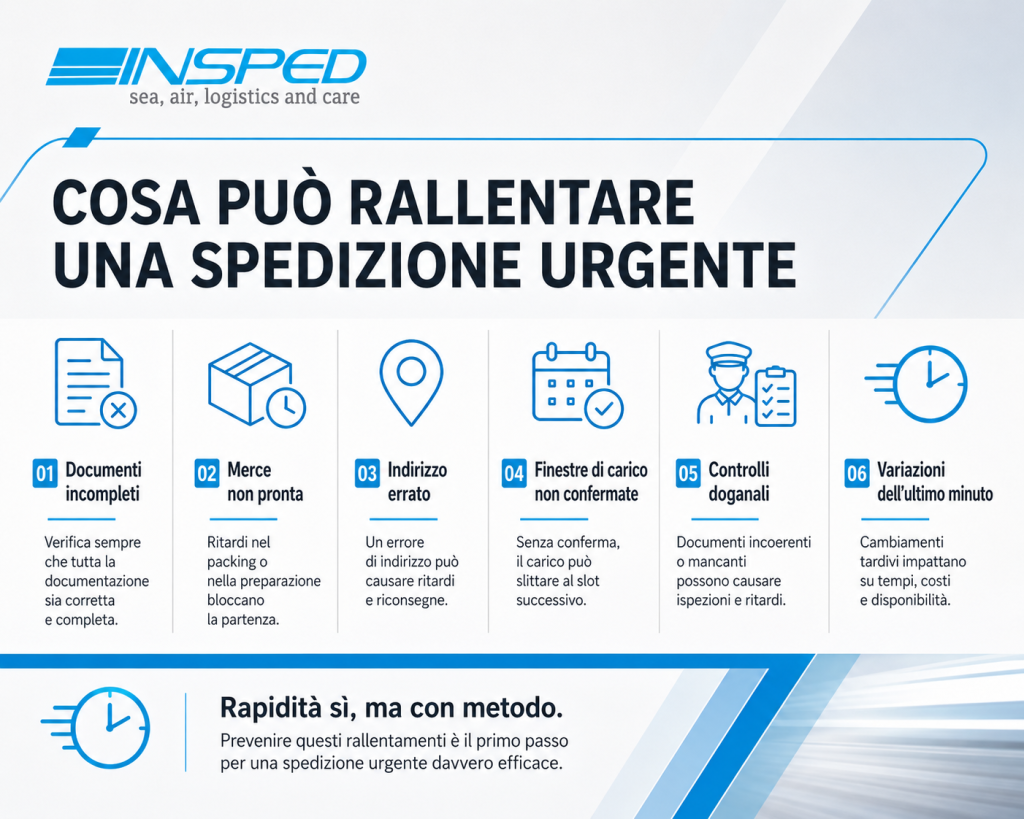
Even when a shipment is handled as a priority, there may be factors that affect delivery times.
Among the most common are:
- incomplete documents;
- goods not ready for pickup;
- incorrect addresses;
- unconfirmed loading or unloading windows;
- traffic or traffic restrictions;
- customs inspections;
- uncoordinated communications;
- last-minute changes.
Urgency does not eliminate these risks.
The difference lies in how they are anticipated and managed.
The problem is not just transportation
Many delays aren’t caused by the journey itself, but by what happens before or after transportation: preparation of goods, documents, recipient availability, access, schedules, and operational confirmations.
For this reason, an urgent shipment requires comprehensive management, not just an available vehicle.
Read also: Goods stuck in customs: what to do and what mistakes to avoid
When Groupage Isn’t Enough
International groupage is a useful solution when the cargo doesn’t fill an entire vehicle and delivery times can be planned.
But for urgent shipments, it isn’t always the best choice.
Consolidated shipping involves consolidation phases, transfers through hubs, and scheduled departures. If the shipment needs to leave immediately or arrive within a very tight time window, it may be necessary to consider a dedicated solution.
Consolidated or urgent: it depends on the objective
If the main goal is to optimize costs and the delivery schedule is predictable, groupage can be an effective option.
If, on the other hand, the main goal is to reduce delivery times and maintain direct control over the delivery, an express or dedicated service may be more suitable.
See also: International groupage—when is it really worth it?
The Value of Experience in Express Shipping
Express shipping requires experience because every situation is different.
There are simple urgent shipments, where the only issue is time. And there are more complex urgent shipments, where documents, customs, international destinations, access issues, special cargo, or multiple parties that need to be coordinated come into play.
In these cases, practical experience helps you ask the right questions before you leave.
The difference between speed and management
Speed and management are not the same thing.
A shipment can leave quickly but be poorly managed.
Or it can be carefully organized, starting at the right time and arriving with less risk.
In B2B logistics, the quality of an urgent shipment depends precisely on the balance between speed and control.
How INSPED Supports Urgent Shipments
INSPED supports companies and operators in managing international shipments, dedicated express services, and urgent transport, evaluating the most suitable solution based on the goods, destination, timing, and available documentation.
The goal is to organize transportation quickly, while also ensuring it aligns with the shipment’s operational needs.
When time is tight, every detail counts: documents, data, pickup, transportation, tracking, delivery, and communication must all work together.
Contact INSPED for expedited shipping
FAQ — Frequently Asked Questions About International Express Shipping
When do you need an urgent international shipment?
An urgent shipment is needed when the goods must arrive within a short timeframe or when a delay could create production, commercial, or organizational problems.
What information is needed to arrange an express shipment?
You’ll need complete information about the goods, weight, volume, pickup location, destination, required delivery times, available documents, and any customs or operational restrictions.
Does an urgent shipment require specific documents?
It depends on the destination and the type of goods. In any case, the documentation must be verified before departure to avoid subsequent delays.
When is it best to choose dedicated transport?
Dedicated transport is recommended when the shipment requires greater control over timing, routing, or delivery management.
Is groupage suitable for urgent shipments?
Not always. Groupage is more suitable for planned shipments. For truly urgent needs, a dedicated or express service may be more appropriate.
How do you handle unexpected events during an urgent shipment?
Through monitoring, rapid communication, document verification, and coordination between all parties involved in the shipment.
Do you need to arrange an urgent shipment?
When time is tight, an urgent shipment requires speed, but also method.
The INSPED team supports companies and operators in managing urgent international shipments, dedicated express services, and customized solutions for B2B transport.