
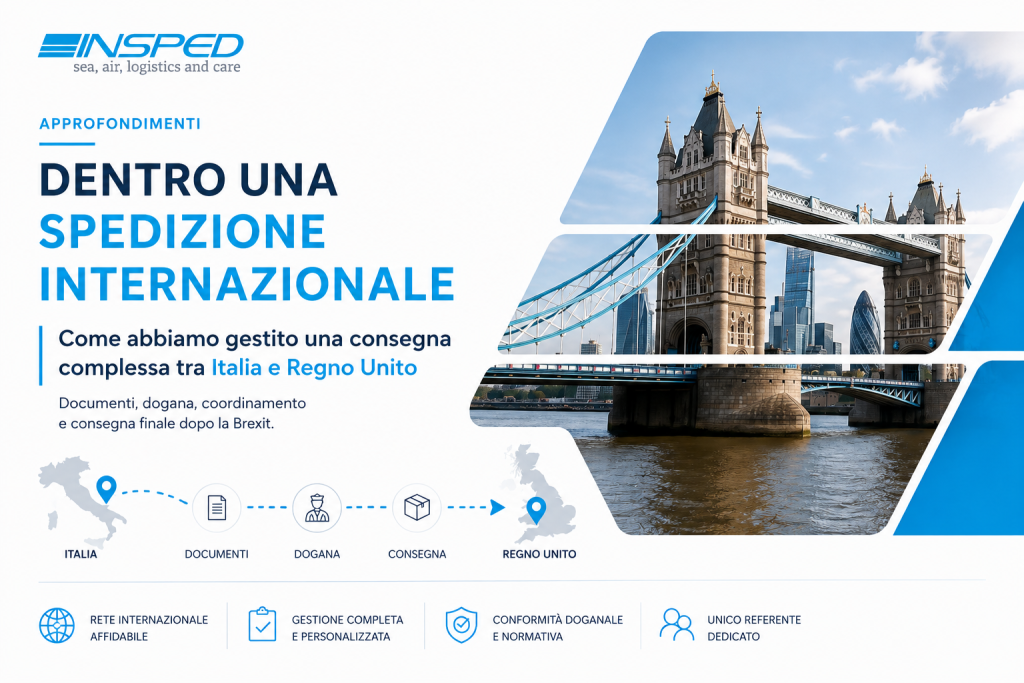
Not all international shipments are complicated because of the distance.
Sometimes complexity arises from a combination of factors: documents, customs, timelines, recipient instructions, border crossings, responsibilities among the parties, and operational coordination.
That’s what can happen with shipments between Italy and the United Kingdom.
After Brexit, the United Kingdom can no longer be treated as a standard intra-EU destination. Even when the route is well-known and transportation is well-organized, shipping requires greater attention to documentation, customs procedures, and operational details.
This case study provides a behind-the-scenes look at an international shipment from Italy to the United Kingdom, showing how a seemingly straightforward delivery can become complicated if all the steps aren’t clarified beforehand.
The value isn’t just in shipping the goods.
It’s about getting it there correctly, with the right documents, on time and without avoidable delays.
Discover the INSPED service for shipments to and from the United Kingdom
The context: a B2B shipment to the UK
The request stems from a concrete need: to organize an international shipment from Italy to the United Kingdom for a B2B client.
The goods had to reach the recipient within a specified timeframe, with the proper documentation and coordination among the various parties involved.
The route was not new, but it presented some elements that required careful handling:
- a destination outside the EU;
- commercial documents to be verified;
- customs information to be reconciled;
- recipient’s operational instructions;
- transit times to coordinate;
- need to avoid delays during border crossing;
- communication between the shipper, carrier, customs, and end customer.
In these cases, the shipment cannot be treated as a simple transport.
It must be set up as a process.
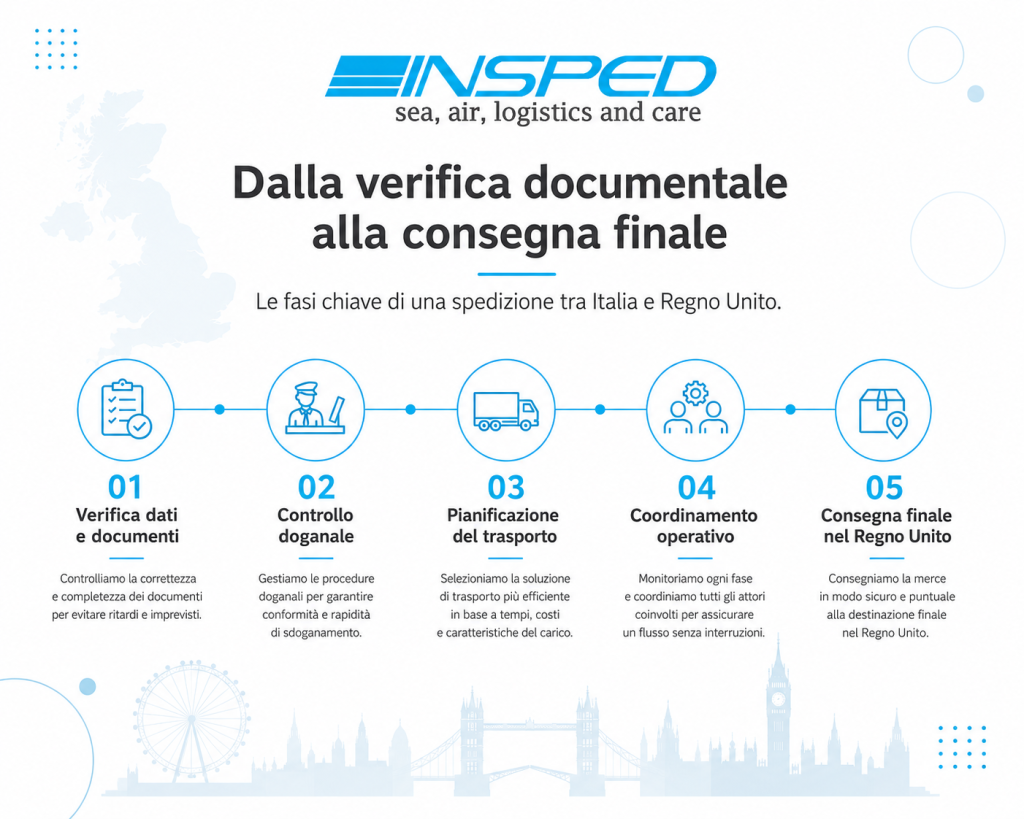
Why the United Kingdom Requires Greater Operational Attention
The United Kingdom is a strategic destination for many Italian companies, but after Brexit, it requires a different approach than for European routes within the European Union.
It’s not enough to simply have the goods ready.
You need to verify that documents, data, codes, responsibilities, and instructions are consistent before departure.
The problem isn’t just customs
When it comes to shipments to the United Kingdom, customs immediately comes to mind.
Customs is certainly a key factor, but it isn’t the only one.
Critical issues can also arise from:
- Incomplete recipient information;
- unclear description of the goods;
- Mismatched documents;
- Inconsistent Incoterms;
- lack of operational references;
- incorrect classification of goods;
- unclear instructions for the carrier;
- information not available at the time of customs clearance.
The risk is that a detail not verified before departure will come to light once the goods are already in transit.
And that’s exactly where making corrections becomes more difficult.
See also: Goods Held at Customs—What to Do and What Mistakes to Avoid
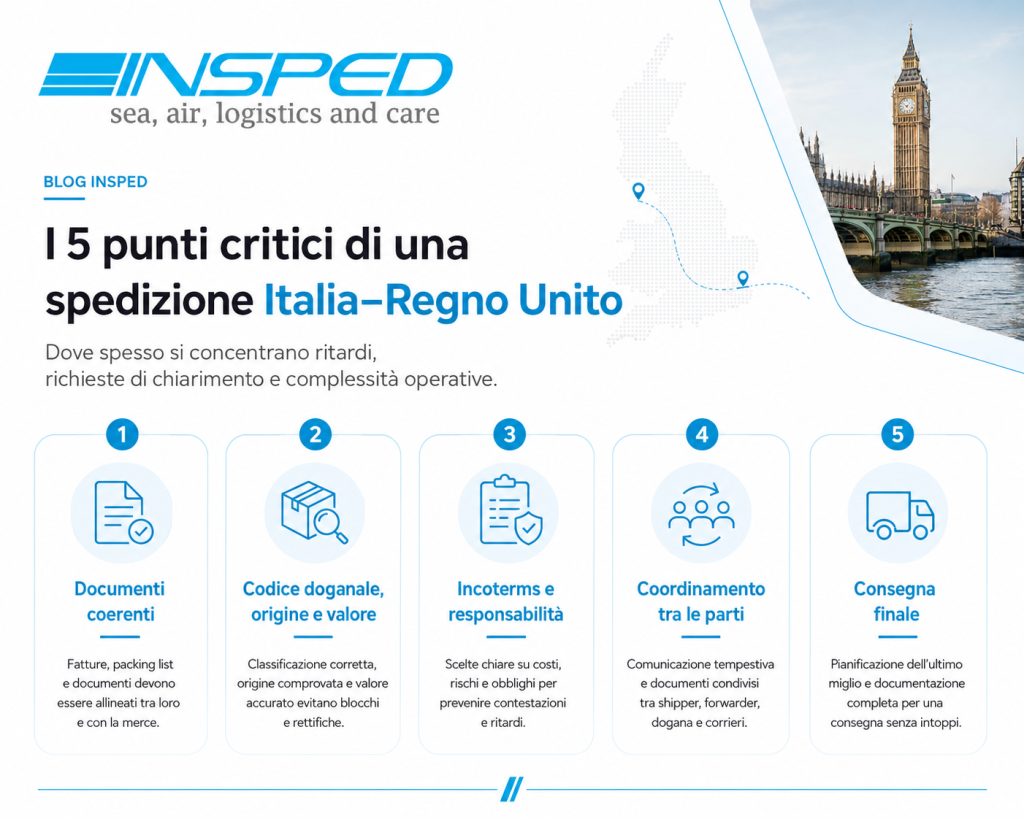
The First Check: Essential Documents and Information
The first phase of the process was verifying the documentation.
For a shipment from Italy to the United Kingdom, the documents must be consistent with one another and must clearly identify the goods, the sender, the recipient, and the shipping conditions.
So we checked the following:
- commercial invoice;
- packing list;
- description of the goods;
- weight and volume;
- number of packages;
- declared value;
- origin of the goods;
- customs code;
- complete sender and recipient information;
- Incoterms;
- any specific instructions from the customer or the recipient.
Document consistency reduces risks
In an international shipment, documents must do more than simply “be there.”
They must all describe the same transaction.
If the invoice lists one figure, the packing list lists another, and the shipping instructions list a third, the risk of being asked for clarification increases.
For this reason, a preliminary check is an essential part of the shipping process, especially when the shipment is bound for the United Kingdom.
See also: Document errors that can hold up an international shipment
The Customs Challenge: Anticipating Potential Issues
One of the most delicate steps was verifying the information needed for customs processing.
For a shipment to the United Kingdom, it is not enough to simply load the goods and arrange for transportation.
We need to verify that the documentation is ready for customs clearance and that there are no discrepancies that could slow down the process.
Classification, Origin, and Value
Three elements are particularly important:
- customs classification of the goods;
- origin of the goods;
- value stated in the documents.
This information affects the proper handling of the shipment and must be verified before departure.
An incorrect customs code, an unclear country of origin, or an inconsistent value can lead to requests for clarification and delays.
Incoterms and Liability
Another important point concerns Incoterms.
When shipping to the United Kingdom, it is essential to clarify who bears certain costs, who handles specific steps, and what responsibilities fall to the sender and the recipient.
Confusion over “who pays” and “who is responsible for handling” is one of the most common issues in international shipping.
Read also: Incoterms: The Most Common Mistakes That Can Cost Time and Money
Choosing the Logistics Solution
Once the documents and data were clarified, the most suitable logistics solution was evaluated.
The choice never depends on just one factor.
For a shipment from Italy to the United Kingdom, you should consider the following:
- type of goods;
- urgency;
- volume;
- final destination;
- required delivery times;
- any intermediate stops;
- recipient’s availability;
- required documentation;
- required level of oversight.
In some cases, a groupage service may be appropriate. In other cases, when time is tight or the goods require closer monitoring, it may be better to consider a dedicated solution.
The right solution isn’t always the fastest one
An efficient shipment isn’t necessarily the one that leaves first.
It’s the one that leaves once all conditions have been verified.
Shipping quickly with incomplete documents or unclear instructions can turn an urgent delivery into a problematic shipment.
For this reason, the logistics decision must be consistent with the documents, timelines, goods, and destination.
Read more: Inside an urgent shipment—what happens when time is tight
Discover INSPED’s dedicated express services
Coordination between the shipper, carrier, and recipient
Managing the shipment required ongoing coordination among the parties involved.
On a route between Italy and the United Kingdom, it is not enough for each party to carry out its own tasks in isolation.
Information needs to flow properly.
What was coordinated before departure
Before the withdrawal, the following were checked:
- availability of goods;
- final documentation;
- loading times;
- recipient information;
- delivery instructions;
- operational steps;
- any customs references;
- updates to share with the customer.
This coordination helped reduce the risk of subsequent errors.
Why Communication Is Part of Shipping
In international shipping, communication is not just a minor detail.
It’s part of the service.
When the shipper, freight forwarder, carrier, and recipient are all on the same page, the shipment is less likely to get held up due to avoidable issues.
The final delivery: where the outcome is often decided
An international shipment doesn’t end once it clears customs.
It ends when the goods are successfully delivered to the recipient.
The final handover can be one of the most delicate moments, especially when there are:
- specific schedules;
- warehouses with internal procedures;
- access rules to be followed;
- requirement for advance notice;
- contact information;
- documents to be presented;
- confirmations of delivery.
For shipments from Italy to the United Kingdom, final delivery must be planned with the same care given to the initial shipment.
That final detail can prevent a delay
An outdated contact, an unconfirmed schedule, or a missing instruction can delay delivery even when the shipment has been handled correctly.
For this reason, coordination with the recipient is an integral part of the shipping process.
The result: a shipment handled methodically
The shipment was managed through preliminary verification, coordination, and operational oversight.
The result does not depend on a single step, but on the alignment of several factors:
- accurate data;
- consistent documents;
- appropriate logistics choices;
- proactive customs clearance;
- clear communication;
- coordination with the recipient;
- final delivery verification.
This is the difference between organizing a shipment and managing an international shipment.
In the first case, the goods are simply moved.
In the second, the process is managed.
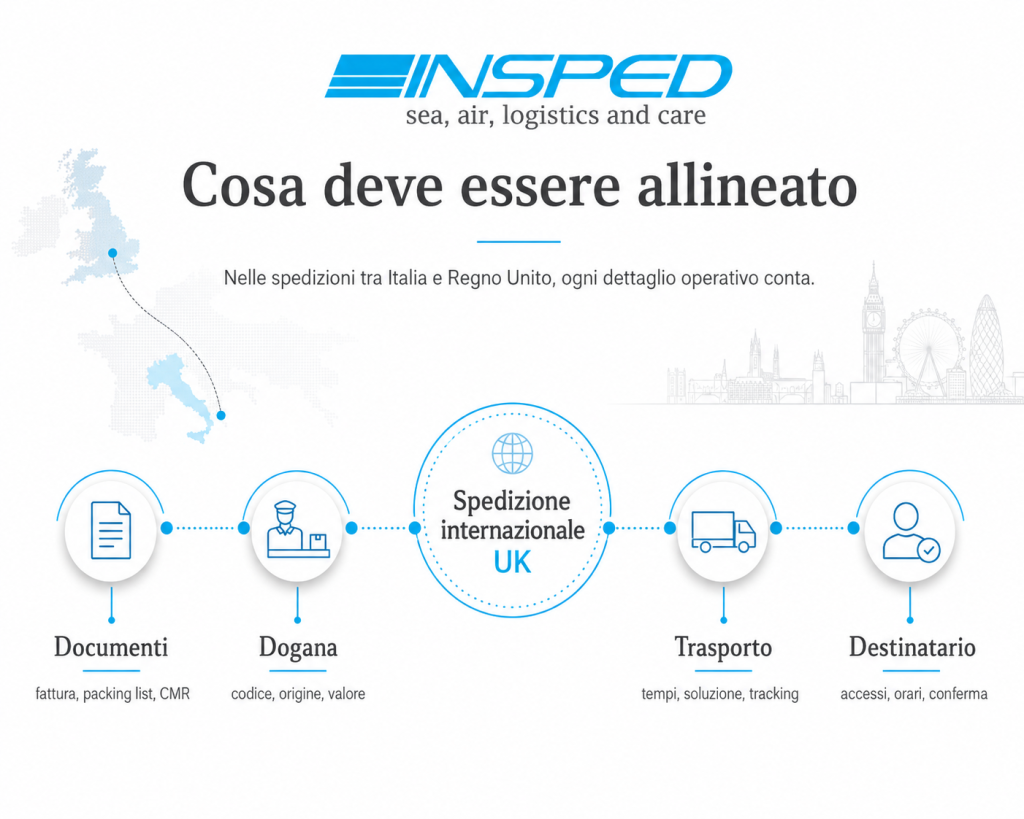
What can companies learn from this case study
?
This case study highlights an important point: even a route as familiar as Italy-United Kingdom can become complex if it is not managed systematically.
Companies that export to the United Kingdom should pay particular attention to:
- commercial documents;
- customs data;
- origin of goods;
- customs classification;
- Incoterms;
- mode of transport;
- timelines;
- delivery instructions;
- communication with the recipient.
Prevention costs less than correction
Many issues can be avoided before shipment.
Correcting a document, clarifying a piece of information, or verifying an instruction while the goods are still in the warehouse is much easier than doing so once the shipment is already in transit.
For this reason, the preliminary phase should not be viewed as mere red tape.
It is a form of shipment protection.
INSPED’s Support for Shipments Between Italy and the United Kingdom
INSPED supports Italian companies in managing shipments to and from the United Kingdom, focusing on international transportation, documentation, customs procedures, operational coordination, and final delivery.
Each shipment is evaluated based on the goods, destination, delivery time, documentation, and requested service level.
The goal is to reduce errors, delays, and critical issues, helping the company manage shipments in an organized, traceable, and consistent manner.
Learn more about shipping to and from the United Kingdom
Discover INSPED’s customs services
FAQ — Frequently Asked Questions About Shipments from Italy to the United Kingdom
Do shipments to the United Kingdom require customs documents?
Yes. Following Brexit, the United Kingdom requires different documentation and customs procedures than those for intra-EU shipments. It is important to verify the documents, goods information, origin, value, and classification before shipment.
What documents are required to ship goods to the United Kingdom?
You may need a commercial invoice, packing list, CMR, sender and recipient information, customs code, country of origin, value, and specific documents depending on the type of product.
Why might a shipment to the UK be delayed?
It can be slowed down by incomplete documents, inconsistent data, incorrect customs classification, unclear Incoterms, lack of operating instructions, or problems with final delivery.
Which is better: groupage or dedicated transport to the United Kingdom?
It depends on the cargo, lead time, volume, urgency, and final destination. Groupage may be suitable for shipments that can be planned in advance, while dedicated transport may be preferable when tighter lead times or greater control are needed.
Are Incoterms important for shipments to the United Kingdom?
Yes. Incoterms help clarify costs, responsibilities, and operational steps between the shipper and the consignee. If they are not consistent, they can lead to delays or disputes.
Does INSPED handle shipments to and from the United Kingdom?
Yes. INSPED supports Italian companies in managing international shipments to and from the United Kingdom, offering transportation services, documentation support, customs coordination, and customized solutions.
Do you need to arrange a shipment from Italy to the United Kingdom?
An international shipment to the United Kingdom involves more than just transportation.
It requires accurate documentation, careful customs clearance, clear communication, and operational coordination all the way through to final delivery.
INSPED supports companies in managing shipments from Italy to the UK, helping to reduce errors, delays, and operational issues.